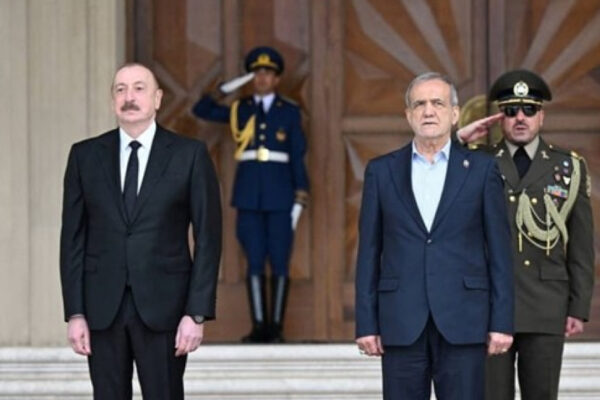
Strategic value of stability amid chaos: Azerbaijani model and strong leadership factor

The contemporary system of international relations is experiencing its most severe period of turbulence in recent decades. The mechanisms of international law that took shape in the post–Cold War era and once provided a degree of stability are no longer capable of managing emerging crises. Escalating confrontation among global power centers, the expanding geography of…

Read more

Restraint without withdrawal: Iran’s evolving approach to forward defense

Iran’s humiliating military setbacks during the twelve-day war, compounded by deepening economic strain under the renewed maximum-pressure campaign, have forced an internal reckoning in Tehran over the country’s domestic social contract and its regional posture. The debate is no longer confined to how Iran should absorb external pressure, but whether the political and economic foundations…

Read more

Topchubashov Center co-hosts international conference in Hungary

On 12 December 2025, Topchubashov Center, in partnership with the John Lukacs Institute for Strategy and Politics (JLI) at Ludovika University of Public Service (NKE), co-hosted an international conference entitled “Conflict and Coexistence in the Near East: Contemporary Dynamics.” The event was held at the John Lukacs Lounge of the Ludovika Side Building in Budapest….

Read more

Azerbaijani Foreign Policy in 2025: Key Highlights

The year 2025 marked a period of adjustment and consolidation in Azerbaijan’s foreign policy. From its immediate vicinity to neighboring regions, Baku approached its external environment not as a challenge to be reacted to, but as an emerging architecture to be proactively shaped in line with its vital interests. The formalisation of peace with Armenia…

Read more

Armenia-Azerbaijan Track 2: the ice is melting

Before the 2020 Karabakh War, the Armenia–Azerbaijan Track 2 diplomacy existed more as an aspiration than a lived reality. Dialogues were episodic, heavily mediated by third parties, geographically distant from the region, and largely disconnected from actual decision-making. Mutual visits were rare to the point of being unthinkable – exceptional and often sensationalized – and…

Read more

Mahammad Mehdiyev speaks at the ASIAC Conference

On 17 December 2025, Topchubashov Center’s Research Fellow Mahammad Mehdiyev delivered a presentation at the ASIAC Conference held in Venice. He presented his research titled “Cartographic Controversies: Google Maps and the Geopolitics of Place Names in Conflict Zones,” in which he examined how digital mapping platforms represent disputed borders and place names, and how these…

Read more

People–state unity: insights from Azerbaijan

People–state unity is one of the core foundations of state resilience. Azerbaijan translated this principle into concrete action during the Karabakh war, gaining a clear strategic advantage. Strong internal consensus enabled the country to mount a firm and coordinated response to external threats. This synergy enhances the effectiveness of economic policymaking. Through social programs that…

Read more