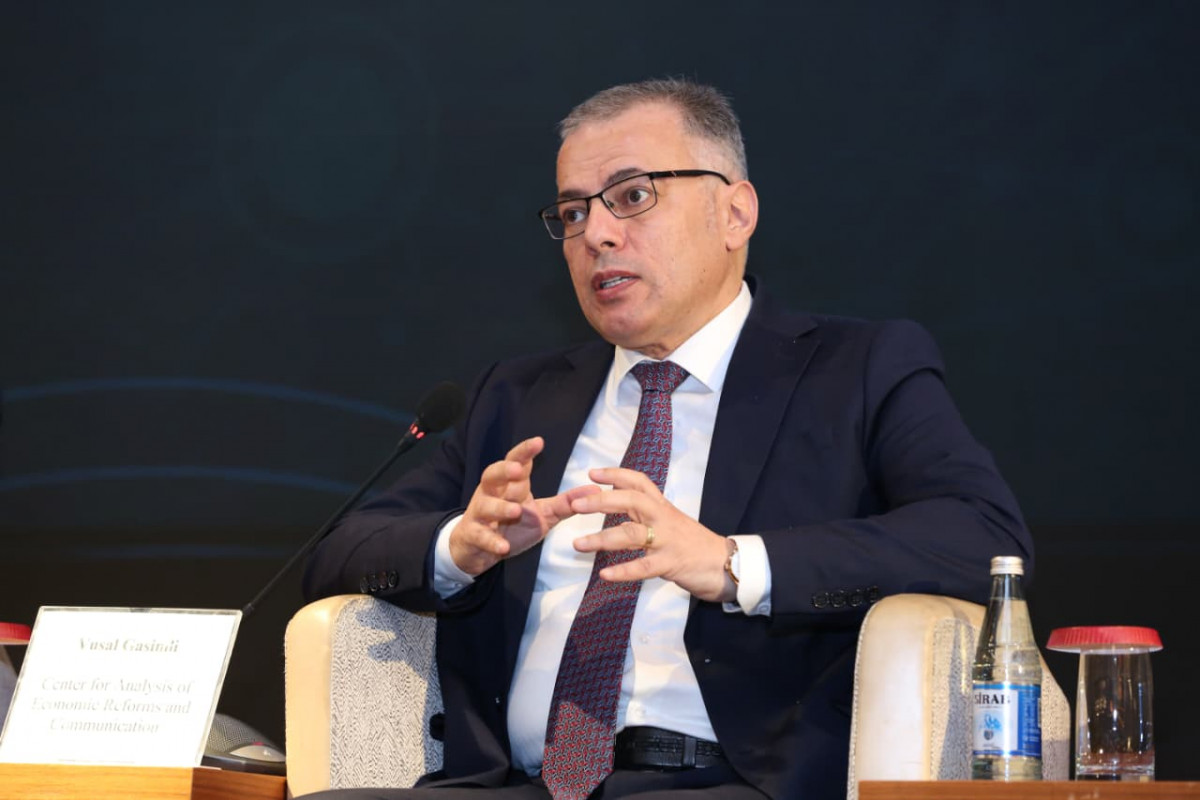
Opening speech of Vusal Gasimli, Executive Director of the Center for Analysis of Economic Reforms and Communication (CAERC), at the IX International Banking Forum:
Distinguished guests and esteemed participants,
I welcome all of you to the IX International Banking Forum held under the theme “Reliable, Secure, and Sustainable Banking.” This Forum represents an important platform where global developments in the banking and financial sector are discussed and forward-looking ideas are shaped.
Today, the banking sector is passing through a period where digitalization intersects with rising security challenges. Data-driven management, digital ecosystems, the transition from open banking to open finance system, real-time payments, and the application of artificial intelligence have already become new standards in banking.
It is evident that consumer behavior is changing, technology is accelerating, and risks becoming increasingly complex. The central task of the banking sector is to balance innovation with security and ensure the transition toward sustainable and reliable systems. The new banking model is no longer built solely on service delivery, it is increasingly shaped by data-driven management, AI-based risk prediction, real-time incident detection, and the application of progressive regulatory standards. At the same time, ESG frameworks, Basel III requirements, and artificial-intelligence-driven approaches in liquidity and risk management have become important components of sustainable development.
The Forum’s agenda demonstrates that fintech–bank cooperation, AI-enabled automated risk monitoring, advanced cybersecurity solutions, digital investment platforms, and blockchain-based operations constitute the foundation of the future financial architecture.
I consider the integration of modern technologies and analytical approaches to be indispensable for shaping a reliable, secure, and sustainable banking sector. In particular, the deployment of artificial intelligence and big data offers transformative opportunities in risk management. These technologies enable banks to assess credit, liquidity, market, and operational risks more proactively and accurately, while real-time analytical decision-making mechanisms provide rapid and agile response capabilities.
At the same time, an ecosystem-based approach plays a critical role in the sustainable development of the banking sector. This approach allows financial institutions to build an integrated and interconnected ecosystem with customers, fintech companies, regulators, and other stakeholders. Such an ecosystem enhances the sector’s resilience through information sharing, innovation incentives, and risk distribution.
Additionally, the progressive and flexible approach of regulators is one of the key factors ensuring the reliability and security of the banking sector. Following technological advancements, regulators must introduce new regulatory frameworks and standards, and support the use of innovative tools such as artificial intelligence and big data in risk management processes. This approach not only strengthens supervisory oversight but also creates a favorable environment for banks to operate innovatively and sustainably. It may be concluded that the formation of a reliable, secure, and sustainable banking sector is possible only through the combined application of technological capabilities, analytical decision mechanisms, ecosystem cooperation, and forward-looking regulatory practices. This approach not only ensures effective risk management but also contributes meaningfully to financial stability, economic development, and public trust.
In conclusion, shaping the new development model of the banking system on the basis of digital transformation, artificial intelligence technologies, open finance ecosystems, and sustainability principles is considered one of the structural economic requirements of our time. The integration of these directions is fundamentally important for enhancing the competitiveness of financial institutions, improving risk management, and ensuring long-term financial resilience.
I wish everyone successful discussions and productive cooperation.
Thank you!