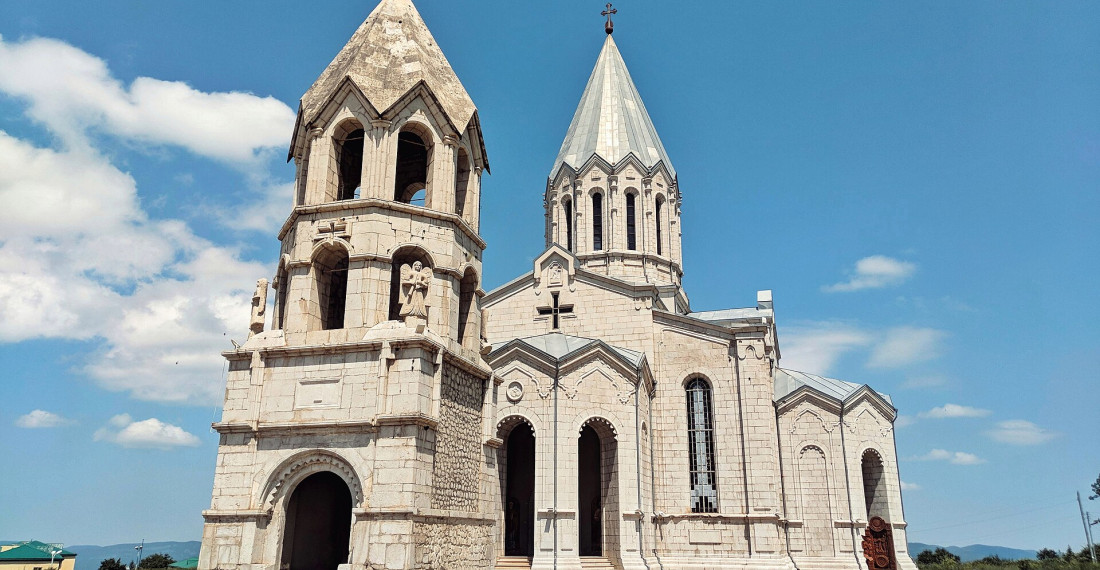
Since the early days of Azerbaijan’s restoration of sovereignty over the formerly occupied Karabagh region in 2020/2023, some Armenian political circles and diaspora networks have accused Baku of destroying Armenian cultural and religious heritage in the liberated territories. The recent claims about the demolition of some structures in Khankandi, Karabakh, have brought this issue back to the agenda, accompanied by assertions that Azerbaijan is attempting to erase an Armenian historical presence. These claims rest on a selective presentation of facts that omits the legal and historical context essential for understanding what is actually taking place.
At the center of the latest controversy are a number of buildings that are portrayed as part of an ancient and continuous cultural legacy. Yet the record shows that these structures are relatively recent and built during the period the region was under illegal occupation of Armenia’s Armed Forces. For instance, the Surb Hakob Church was constructed in 2007, less than 20 years ago and erected during the occupation period. The other churches that are mentioned in the latest claims are not any older. These churches are not medieval monasteries or long-standing heritage sites. They are modern constructions, built without the consent of the internationally recognized state authority.
This distinction is not a minor detail; it is the starting point for any meaningful legal analysis. The question is not whether religious structures deserve protection in general – they do – but whether structures built in violation of international law can subsequently claim the same legal protections as lawfully established cultural heritage. International law provides a clear answer.
Any honest legal assessment of these structures must begin with one of the foundational maxims of international law: ex injuria jus non oritur — “law does not arise from injustice.” This principle is not a technicality. It is a fundamental concept of the international legal order, holding that a legal right or entitlement cannot arise from an unlawful act or omission. A state which obtains land by non-defensive war or other aggressive action cannot claim any legal rights to the territory unlawfully obtained, nor can it generate, through its illegal occupation, derivative legal claims to the structures, settlements, or monuments it erects on that territory.
Applied to Karabagh, the principle is decisive and applies with equal force to every permanent structure built in the region during the occupation period — churches, cathedrals, civic monuments, statues, administrative buildings, and any other installation erected without the consent of the sovereign state. Each of these structures was raised in direct consequence of an unlawful military occupation condemned by four binding UN Security Council resolutions. No legal right — including any right of preservation, protection, or cultural heritage status — can flow from that unlawful foundation. The Armenian occupation did not produce legally recognisable facts. The structures it spawned are not legal facts. They are consequences of internationally wrongful acts and fall outside the protective scope of international cultural heritage law as a matter of first principle.
International cultural heritage law, including the 1954 Hague Convention, was designed to protect existing and lawfully constituted cultural property, particularly from damage inflicted by occupying powers. It was not intended to shield structures erected by those powers in violation of international law. To interpret it otherwise would invert its purpose, allowing unlawful acts to generate legal protections simply by attaching a cultural or religious label.
Nor does the religious character of a building alter this legal reality. Freedom of religion is a protected right, but it does not extend to constructing places of worship in violation of property rights or sovereignty. European human rights jurisprudence has made clear that religious function does not retroactively legalize unlawful construction.
The law of state responsibility further clarifies the consequences. Where an internationally wrongful act has occurred, the responsible state is obliged to remedy the situation, including through restitution – restoring conditions to what they were before the violation. In cases of occupation, this principle supports the removal of structures unlawfully established during that period once sovereignty is restored. Seen in this light, the demolition of such structures is not an act of cultural destruction but a legal consequence of ending an unlawful situation.
This legal perspective stands in contrast to the narrative of deliberate cultural erasure. Azerbaijan’s broader record debunks such claims. An Armenian church in central Baku has been preserved as a protected cultural monument for decades. Following the 2020 war, Azerbaijani authorities undertook the restoration of the Ghazanchetsots Cathedral in Shusha using state funds. Across the country, sites belonging to different religious communities, including Christian and Jewish heritage, continue to be maintained. These examples do not support the portrayal of a state pursuing a policy of religious or cultural targeting.
What the current controversy ultimately reveals is not only a legal dispute but also an asymmetry in how cultural heritage issues are framed and received internationally. The destruction of Azerbaijani cultural and religious sites during the decades of occupation received limited global attention. By contrast, the removal of recently constructed structures built under conditions of occupation has generated widespread discussions.
According to Azerbaijan’s Ministry of Culture, more than 400 cultural and religious monuments, including 65 of the 67 mosques, were destroyed in the occupied territories during the years of Armenian occupation. The pattern was not confined to the Karabagh region. It extended into the territory of present-day Armenia itself — where Azerbaijanis constituted a major component of the population of cities like Yerevan for centuries, and from which about 300,000 Azerbaijanis had to leave in the late 1980s. Many of the cultural heritage, cemeteries, mosques, and other monuments belonged to these people have been destroyed or reattributed.
Set against this thirty-year record, the current accusations against Azerbaijan acquire a particular character. The distinction at the heart of this issue is neither obscure nor controversial in legal terms.
Cultural heritage that is historically rooted and lawfully established merits protection, regardless of its origin.
Structures built in violation of international law do not acquire legitimacy simply because they serve a religious function. The principle ex injuria jus non oritur captures this logic in its simplest form: unlawful acts cannot produce lawful rights.
Understanding the current situation in Karabagh requires moving beyond rhetoric and examining the legal framework that governs it. When that framework is applied consistently, the events in Khankendi appear not as acts of cultural erasure, but as part of the legal and material consequences of bringing an unlawful occupation to an end.
https://www.commonspace.eu/opinion/opinion-karabakhs-heritage-controversy