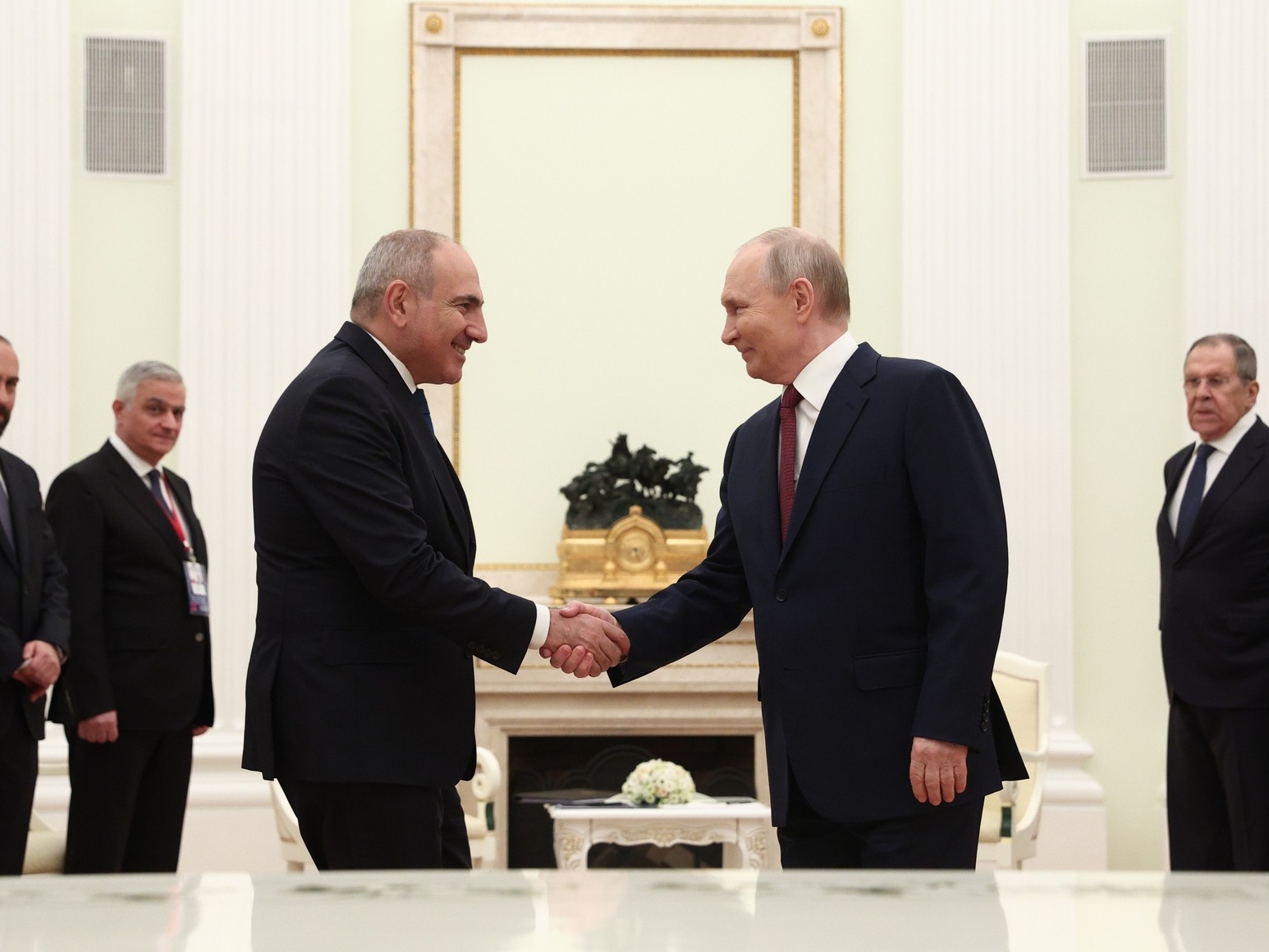
Last week, Armenian Prime Minister Pashinyan in a rather unexpected manner paid a visit to Moscow, reportedly fixed at his own request. During his visit, Armenian leader was accompanied by Deputy Prime Minister Mher Grigoryan and Foreign Minister Ararat Mirzoyan (Aysor.am, April 1). Arguably, the visit was dictated by the pre-election logic: Pashinyan, routinely accused by the opposition of disregarding or even sabotaging relations with Russia, had publicly emphasized (Haqqin.az, March 28) that “he is not afraid” of travelling there and meeting Russian President Putin one-on-one.
However, the visit stirred debates primarily due to the unusually outspoken and sincere character of the public part of the Pashinyan-Putin conversation, which basically turned into an exchange of position statements instead of an exercise in diplomatic niceties and doublespeak such meetings usually tend to be. Later on, the points of rupture which stood out during the short televised dialogue, were elaborated (TASS, April 2) by Russian Deputy Prime Minister Overchuk in his comprehensive interview to the State Information Agency (TASS), and the scope of the Kremlin’s accumulated frustration with Yerevan’s increasingly bold foreign policy stance became fully clear. At the same time, these statements can be interpreted as ground testing for the fateful parliamentary elections due early June, which are set to define Armenia’s political course at least for the medium term.
During this televised dialogue, Vladimir Putin raised (Eurasinet.org, April 3) the issue of Armenia’s declared European integration, emphasizing that it would be impossible for Armenia to combine EU accession process with its EEU membership, to which his Armenian counterpart replied with a remark that it will be up to the Armenian people to decide on their preferences between the two blocks if time comes to make a choice. For Armenia, the EU issue is quite a divisive one: while Pashinyan’s government has consistently pursued a course towards foreign policy diversification and gradual alignment with the Western institutions, Russia remains by far the most significant economic partner. Bilateral trade had skyrocketed since the imposition of heavy Western sanctions against Moscow, and surpassed (Caucasus Watch, June 8, 2025) $12 billion in 2024, mostly as Armenia became one of the key hubs for sanction evasion and re-export of European goods. Against this background, Armenian GDP recorded robust growth rates in the recent years, partly compensating for the government’s reputational losses from its defeats vis-a-vis Azerbaijan. Russia is well aware that the economic shock from an abrupt rupture of dense ties between Yerevan and Moscow would be severe, and can destabilize domestic political balance, of which Putin and Overchuk reminded rather openly. The latter even claimed (TASS, April 2), probably mocking Pashinyan’s “Real Armenia” concept, that “in the real world Armenian businesses are gaining mostly from the Eurasian market” and any attempts to replace it with the European one would be ill-founded and vain. He also reminded that Armenia’s EU membership would mean the cessation of direct air connectivity between Armenia and Russia, due to the existing sanction measures, which would have severe consequences beyond mere economic harm: most Armenians have relatives, friends or business partners living in Russia, turning this issue into a very sensitive one.
Moscow’s economic significance for Armenia isn’t limited by their multi-billion trade turnover and the common market though. During the 20 years of the so-called “Karabakh clan” rule, Russia had acquired strategic assets within Armenia via local branches of its state companies, most significantly electricity production and railway operation. While Moscow considered these assets as a guarantee of its long-term interests in the country, Pashinyan’s government views them as too big a vulnerability for an Armenia that intends to have a more independent foreign policy. Recently, Cosntitutional Court confirmed (TASS, March 12) the legality of the government’s decision to fully nationalise the Armenian Electric Grid company which had belonged to the Russian oligarch of Armenian origin Samvel Karapetyan, who upon his return to Armenia founded an oppositional party “Strong Armenia”. As Karapetyan is widely viewed as a Russian trojan within Armenian politics, the aforementioned decision acquired very clear political undertones.
However, potential contestation of Russian ownership over the country’s railways could produce much stronger consequences. This issue acquired relevance against the background of the peace process with Azerbaijan and Yerevan’s сoncomitant plans for restoring communications with its long-time enemy, including the disused parts of the railway grid waiting for reconstruction. Initially, Yerevan sent a formal query (OC Media, December 19, 2025) to Moscow regarding its willingness to conduct reconstruction works. After a positive reply though, Armenian government stated that Russia’s continued control of the railways may weigh negatively on their plans to turn Armenia into a logistical hub, pushing suppliers to use alternative routes. Hence, Yerevan suggested Moscow could consider selling (JAMNews, February 26) its railway assets to one of “friendly countries” (such as Kazakhstan or UAE) with an experience in this field.
This proposal was clearly not met well in Moscow: Russian experts largely believe Pashinyan is just trying to find a pretext to further diminish Russian presence in the country. The Kremlin’s suspicions are supported by the debate around the future of the Armenian nuclear sector: the existing Metsamor plant, serviced by the Russian atomic agency Rosatom, is in a dire need of renovation, but Yerevan is now considering to switch to the concept of small modular reactors actively promoted by the United States. US’ intention to enter Armenian nuclear energy production was confirmed (Al Jazeera, February 10) during the visit of Vice President JD Vance this February. In his aforementioned interview, Overchuk expressed scepticism regarding American capacity and willingness to implement these plans, emphasizing that Rosatom already has available technological know-how and resources to do the same work much more quickly.
However, it was President Putin’s touching upon (Asbarez, April 1) the issue of Karabakh that most succinctly summarised Moscow’s agenda regarding Pashinyan. The success of bilateral peace process between Baku and Yerevan following the withdrawal of Russian peacekeepers from Karabakh in 2024, and the fact that the agreement was initialed in Washington instead of Moscow, fed into alarmist sentiments regarding South Caucasus, in the Kremlin. Despite his previous endorsements of the normalisation between the two old adversaries, Putin this time made a statement that it was Pashinyan’s recognition of Azerbaijan’s territorial integrity that brought the conflict out of the international agenda. At the moment when Armenian opposition parties have built their electoral campaigns on exposing Pashinyan’s apparent “treason” and “surrender” to Baku, Putin’s statements are aimed at sending a message that the current government traded Karabakh for the chance to decouple from Russia. To leave no doubt, Russian leader even openly “asked” (Asbarez, April 1) his Armenian counterpart to ensure the participation of “Russia’s friends” in upcoming elections, probably implying all the three major opposition parties, but primarily Karapetyan, by far the most popular of them. Azerbaijan’s MFA read this scheme quite unambiguously, issuing a statement (1news, April 5) expressing concern with the Kremlin’s raising of the Karabakh issue.
The public spectacle in the Kremlin means the intensification of the accumulating tensions between Yerevan and Moscow, the latter looking ready to take a more pro-active stance in trying to trigger governmental change in its former republic. Growing unease with the inability to end the war in Ukraine, as well as the implications of the Iranian conflict which may endanger US presence in the South Caucasus, could have prompted Putin to take desperate measures to halt Armenia’s strategic course towards diminishing its dependence on Russia. By exploiting the Karabakh trauma, and resorting to the whole arsenal of thinly veiled economic threats, Moscow might hope to embolden complimentary political forces in Armenia at the elections that can have a generational significance for the country’s development. Nikol Pashinyan must have grasped the scale of change in Putin’s demeanour, resorting himself to incredibly bold, if not reckless, comparisons of Armenian freedoms to Russian blockages of internet- in contrast to his traditionally careful and reserved tone vis-a-vis Putin. At the same time, this policy further alienates Baku, whose relations with Moscow have already strongly deteriorated since late 2024, and in case of Pashinyan’s party winning in the June 7 elections, the normalisation process will likely pass the point of no return.