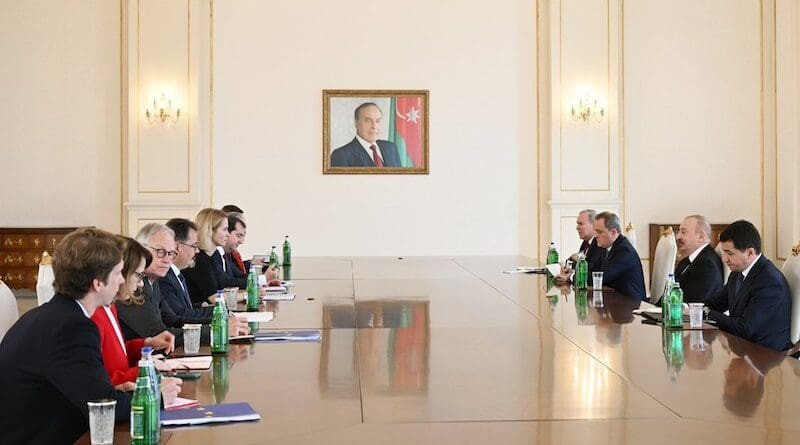
Over the three decades since the restoration of the independence of the Republic of Azerbaijan, relations between Azerbaijan and the European Union (EU) have evolved dynamically. Encompassing political dialogue, economic cooperation, energy partnership, and security matters, these relations have become an important component of Azerbaijan’s foreign policy and the EU’s South Caucasus strategy.
Official ties between Azerbaijan and the EU began to take shape from the early years of Azerbaijan’s independence. After Azerbaijan regained its independence in 1991, the European Union recognized the country as a sovereign state and started providing political and economic support. In 1996, the “Partnership and Cooperation Agreement” was signed between the Republic of Azerbaijan and the EU in Luxembourg, and it entered into force in 1999. The agreement created a framework for cooperation in political dialogue, trade, investment, legal reforms, science, and culture. Azerbaijan joined the EU’s “European Neighbourhood Policy” in 2004 and the “Eastern Partnership” initiative in 2009. These steps marked a new phase in Azerbaijan’s European integration process, contributing to accelerated reforms and institutional development.
In the early years of independence, the EU provided technical and humanitarian assistance to Azerbaijan (for example, under the TACIS and ECHO programs). Azerbaijan, in turn, drew the EU’s attention as an attractive partner thanks to its transit potential, energy resources, and strategic geographic location. In 2006, a Memorandum of Understanding on a Strategic Partnership in the field of energy was signed in Brussels, defining the main directions of cooperation in this sector. In 2014, the visa facilitation and readmission agreements between Azerbaijan and the EU entered into force, helping ease the movement of people. In subsequent years, dialogue and cooperation continued across various fields, with the EU providing financial and technical support for Azerbaijan’s economic diversification, the strengthening of the rule of law, and other reform initiatives. Overall, in a historical context, Azerbaijan-EU relations have been shaped on the basis of mutual interest and respect, though they have occasionally faced challenges stemming from global and regional developments.
Azerbaijan and the European Union occupy an important place in each other’s geopolitical interests. One of the EU’s primary goals in the South Caucasus is to promote stability, security, and economic development. From this perspective, Azerbaijan carries strategic significance for the EU in several respects. First, Azerbaijan’s energy resources-especially oil and natural gas-play a critical role in the EU’s strategy of diversifying energy supplies. Second, Azerbaijan’s geographical location between Europe and Asia makes it a key transport and logistics hub; its participation in initiatives such as the Trans-Caspian route and the Middle Corridor offers the EU new opportunities for connectivity with Central Asia and China. Third, Azerbaijan acts as a cultural bridge between the Muslim East and the Western world, standing out as a secular and multicultural country in the EU’s neighborhood.
The EU also holds an important place in Azerbaijan’s foreign policy priorities. The EU is Azerbaijan’s largest trading partner and a major source of investment. A significant portion of Azerbaijan’s exports-particularly crude oil and natural gas-is directed to European markets, making the EU highly influential in Azerbaijan’s economy. Politically, Azerbaijan views cooperation with the EU as a platform to advance its interests internationally. For example, the EU’s official acknowledgment of Azerbaijan’s internationally recognized borders strengthens Baku’s confidence in the Union. Additionally, consistent with its balanced foreign policy strategy, Azerbaijan sees the EU as a significant actor alongside Russia, Turkey, and China in the broader geopolitical landscape. By cultivating close relations with the EU, Azerbaijan aims to safeguard its security and sovereignty interests while integrating more deeply into the global economic system.
Energy cooperation is one of the leading dimensions of Azerbaijan-EU relations. Azerbaijan’s rich hydrocarbon reserves and favorable geographical position give it a special place in the EU’s energy security policy. For many years, the European Union has pursued a strategy of diversifying energy suppliers, particularly looking to the Caspian region-and especially Azerbaijan. The 2006 memorandum on strategic energy partnership and subsequent dialogues formed the basis of Azerbaijan-EU energy cooperation. One of the most significant outcomes of this cooperation was the creation of the Southern Gas Corridor infrastructure. Completed in 2018, this extensive pipeline system has enabled the direct delivery of Azerbaijani natural gas to European markets since the end of 2020. This was a major shift in Europe’s energy map, providing the EU with a reliable alternative to Russian gas.
Azerbaijan’s role in the EU’s energy supply has expanded further in recent years. In particular, the energy dialogue between Baku and Brussels intensified against the backdrop of the EU’s efforts to reduce its dependence on Russian gas following the Russian-Ukrainian war of 2022. In July 2022, a new Memorandum of Understanding on energy cooperation was signed between the EU and Azerbaijan, setting the goal of roughly doubling gas supplies from Azerbaijan to the EU by 2027. By 2024, the annual volume of gas exported to the EU had already increased significantly compared to a decade earlier. Azerbaijan has also long been a major supplier of oil to Europe-Caspian crude is transported to the Mediterranean via the Baku-Tbilisi-Ceyhan pipeline and from there to world markets, including Europe. Azerbaijan currently maintains a stable share in the energy balance of many European countries and holds strategic supplier status, particularly for several Southern European states.
Energy cooperation is not limited to fossil fuels. The EU and Azerbaijan are exploring partnership opportunities in renewable energy and the “green economy.” Given Azerbaijan’s strong wind and solar potential, the country is cooperating with several European companies on the development of wind power plants and digital energy solutions. In 2022, the leaders of Azerbaijan, Georgia, Romania, and Hungary signed an agreement on constructing an undersea electric cable across the Black Sea. This project may enable the export of renewable electricity generated in Azerbaijan’s Caspian coastal regions to EU countries in the future. Thus, Azerbaijan intends to contribute to Europe’s long-term energy security not only through oil and gas but also through alternative energy sources.
The 44-day Second Karabakh War in 2020 created new geopolitical realities in the South Caucasus. Following the war, Azerbaijan regained control over most of its territories previously under occupation, and a tripartite ceasefire statement was signed on November 10, 2020, with Russia’s mediation. However, achieving a lasting peace agreement and full normalization of Armenia-Azerbaijan relations remained a pressing issue. At this stage, the European Union became more actively engaged in the regional peace process.
Since late 2021, EU leadership-particularly President of the European Council Charles Michel-has taken steps to facilitate direct dialogue between the leaders of Azerbaijan and Armenia. The first trilateral meeting mediated by the EU took place on December 14, 2021, in Brussels between President Ilham Aliyev and Prime Minister Nikol Pashinyan. Additional high-level meetings were held in Brussels in April and May 2022. These engagements helped establish direct communication between the parties and enabled initial agreements on key issues such as the formation of a joint border delimitation commission and the opening of transportation links. After each meeting, Charles Michel emphasized the EU’s support for the process and the importance of concrete steps-such as restoring transport routes and addressing humanitarian issues-for achieving long-term peace in the region. For the first time, Armenia officially recognized Azerbaijan’s territorial integrity within the EU platform. Overall, in 2021-2023, the EU contributed positively to the peace efforts. However, certain problems also emerged in relations during the post-conflict period.
Despite generally positive developments, some challenges and tensions have surfaced in Azerbaijan-EU relations. A number of these stem from decisions and statements issued by EU institutions concerning Azerbaijan. The European Parliament, in particular, has adopted several resolutions in recent years that Azerbaijan considers biased. For instance, in early 2023, the European Parliament issued a resolution accusing Azerbaijan of creating a blockade regarding the humanitarian situation in Karabakh. Later in the autumn of 2023, based on Armenian claims, the Parliament called on the EU to label Azerbaijan’s actions as “ethnic cleansing.” Baku firmly rejected these accusations, describing the Parliament’s position as biased and damaging to mutual trust.
Another issue relates to the EU’s monitoring mission deployed in Armenia. Established on the Armenian side of the Armenia-Azerbaijan border in 2023, this mission was met with objections from Azerbaijan, which views the initiative as unilateral and implemented without its consent. According to Azerbaijani officials, the mission encourages Armenia to take a less constructive stance in peace negotiations. Thus, the EU monitoring mission has become a factor undermining mutual confidence.
A further source of tension is the position of certain EU member states, particularly France. In the post-conflict period, France has openly adopted a pro-Armenian stance. Following the 2020 war, high-level French officials issued harsh condemnations of Azerbaijan. Moreover, both chambers of the French Parliament adopted resolutions in 2022 and 2023 calling for sanctions against Azerbaijan and even for recognition of the separatist entity in Karabakh. These steps prompted strong reactions from Baku, leading Azerbaijan to reject France’s role as a mediator.
The legal framework of Azerbaijan-EU relations is currently defined by the 1999 Partnership and Cooperation Agreement. However, in recent years, both sides have been working to update this framework and sign a more comprehensive, strategic partnership agreement. Formal negotiations on such an agreement began in 2017. The aim is to establish a deeper cooperation framework covering political dialogue, economic ties, trade, energy, transportation, human rights, and other fields. Nevertheless, differing approaches to certain issues have complicated the finalization of the agreement.
If signed, the new comprehensive agreement is expected to give fresh impetus to Azerbaijan-EU relations. It may define reciprocal commitments more clearly, institutionalize political dialogue, and facilitate Azerbaijan’s access to EU markets. Such an agreement, which would raise bilateral relations to the level of strategic partnership, will largely depend on progress in the ongoing peace process and the presence of sufficient political will. If substantial advancements are made in Armenia-Azerbaijan normalization and mutual trust increases, the signing of the agreement will become more realistic.
In conclusion, relations between Azerbaijan and the European Union are multifaceted and strategic. Historical development shows that cooperation based on mutual benefit has produced significant achievements. One of the main pillars of this partnership is Azerbaijan’s contribution to Europe’s energy security. The EU, in turn, has supported Azerbaijan’s economic modernization and institutional development through various programs. Political relations, however, have at times faced challenges-especially due to the consequences of the former Armenia-Azerbaijan conflict and differing views on certain political issues. Overall, from a conceptual perspective, the partnership between Azerbaijan and the EU is complex but carries strong potential for further development. Realizing this potential will require pragmatism, mutual trust, and sustained dialogue. As the parties deepen cooperation founded on shared strategic interests, a long-term partnership contributing to peace and prosperity for both Azerbaijan and the European Union may be achieved.