Azerbaijani Foreign Policy in 2025: Key Highlights

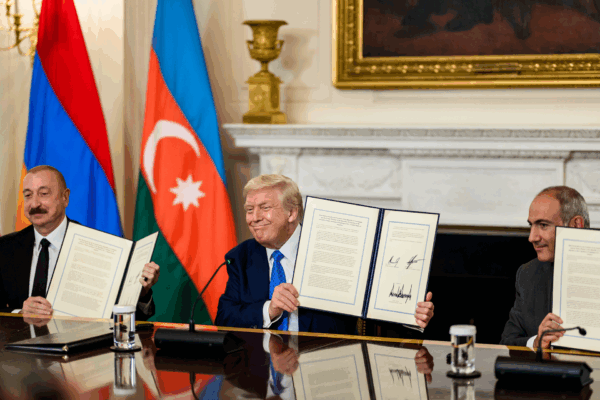
The year 2025 marked a period of adjustment and consolidation in Azerbaijan’s foreign policy. From its immediate vicinity to neighboring regions, Baku approached its external environment not as a challenge to be reacted to, but as an emerging architecture to be proactively shaped in line with its vital interests. The formalisation of peace with Armenia…

Read more

Armenia-Azerbaijan Track 2: the ice is melting

Before the 2020 Karabakh War, the Armenia–Azerbaijan Track 2 diplomacy existed more as an aspiration than a lived reality. Dialogues were episodic, heavily mediated by third parties, geographically distant from the region, and largely disconnected from actual decision-making. Mutual visits were rare to the point of being unthinkable – exceptional and often sensationalized – and…

Read more

Mahammad Mehdiyev speaks at the ASIAC Conference

On 17 December 2025, Topchubashov Center’s Research Fellow Mahammad Mehdiyev delivered a presentation at the ASIAC Conference held in Venice. He presented his research titled “Cartographic Controversies: Google Maps and the Geopolitics of Place Names in Conflict Zones,” in which he examined how digital mapping platforms represent disputed borders and place names, and how these…

Read more

People–state unity: insights from Azerbaijan

People–state unity is one of the core foundations of state resilience. Azerbaijan translated this principle into concrete action during the Karabakh war, gaining a clear strategic advantage. Strong internal consensus enabled the country to mount a firm and coordinated response to external threats. This synergy enhances the effectiveness of economic policymaking. Through social programs that…

Read more

The Black Sea fault line: how sanctions and fragmentation are rewriting the region’s energy order?

As Western sanctions on Russia intensify, targeting not only the country’s financial apparatus but also major companies and energy champions such as LukOil, Rosneft, and Gazprom Neft, the Black Sea has become the most dynamic fault line in Europe’s reconfigured energy landscape. The accelerated withdrawal of these Russian companies from the region is not simply…

Read more

Rusif Huseynov speaks at HIIA panel session

On 10 December 2025, Topchubashov Center Director Rusif Huseynov joined a panel session entitled “The Armenian-Azerbaijan peace process – From frozen conflict to hot peace.” Hosted at the Hungarian Institute of International Affairs, the panel also featured Armenian, Georgian, and Hungarian experts. In his remarks, Rusif Huseynov assessed the peace process and connectivity between Armenia…

Read more

Rusif Huseynov speaks at Danube Institute conference

On 9 December 2025, Topchubashov Center Director Rusif Huseynov joined the Inaugural Turkic-Western Geopolitical Dialogue organized by the Danube Institute and spoke in one of the panel sessions. His remarks mainly covered the role of the Turkic countries, particularly Azerbaijan, in the European energy security. He also emphasized Hungary’s unique role as a bridge state…

Read more