webmaster

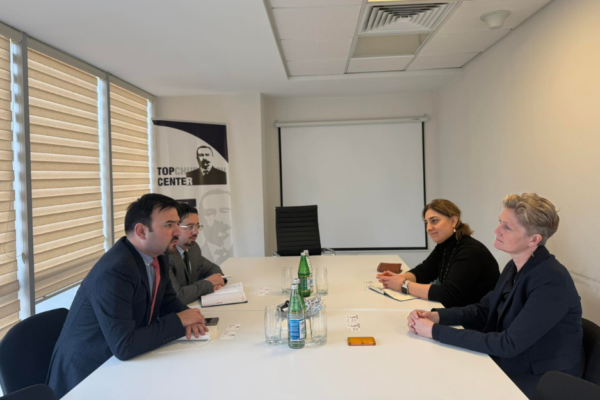
Vusal Gasimli hosts delegation from the Kingdom of the Netherlands

Vusal Gasimli, Executive Director of the Center for Analysis of Economic Reforms and Communication (CAERC), received a delegation consisting of Caroline Ramaekers, Head for Eastern Europe of the Kingdom of the Netherlands; Rebel Reyper, Senior Adviser of the Ministry of Foreign Affairs of the Netherlands; Marianne de Jong, Ambassador of the Kingdom of the Netherlands…

Read more

Vusal Gasimli delivered opening remarks at the IX International Banking Forum

Opening speech of Vusal Gasimli, Executive Director of the Center for Analysis of Economic Reforms and Communication (CAERC), at the IX International Banking Forum: Distinguished guests and esteemed participants, I welcome all of you to the IX International Banking Forum held under the theme “Reliable, Secure, and Sustainable Banking.” This Forum represents an important platform…

Read more

SRC hosts int’l conference on State Sovereignty and National Constitutions in the 21st Century: Global Challenges, Trends and Prospects

The Social Research Center, in collaboration with the Faculty of Law at Istanbul University, has held an international scientific and practical conference in Baku on “State Sovereignty and National Constitutions in the 21st Century: Global Challenges, Trends and Prospects”. The conference was held as part of the “2025: The Year of Constitution and Sovereignty” in…

Read more

Gulkhanim Mammadova participates in training in Vienna

From 10–14 November, Gulkhanim Mammadova from Topchubashov Center participated in a training jointly organized by the OSCE Secretariat and the Friedrich Ebert Foundation (FES) for the OSCE Pool of Young Experts. The training focused on strengthening professional competencies in peace and security, with a particular emphasis on negotiation skills. Gulkhanim is a member of the…

Read more

Military power balance: The regional reality of the U.S.–China rivalry

The likelihood of military confrontation between the United States and China has, in recent years, become one of the most manipulated and simultaneously most misinterpreted subjects in global politics. Although many describe this rivalry as a simple “clash of two superpowers,” the actual dynamics are far more complex: a structural mismatch has emerged between Washington’s…

Read more

The strategic logic of Azerbaijan–U.S. relations in a multipolar era

Azerbaijan–U.S. relations today transcend the binaries of historical friendship and past discord. They reflect the convergence of strategic rationality, shifting geopolitical configurations, and the maturation of Azerbaijan’s multi-vector diplomacy. President Ilham Aliyev’s remark that “Azerbaijan–U.S. relations entered a new phase following Donald Trump’s election” encapsulates a profound strategic transition — one rooted in the transformation…

Read more

Topchubashov Center hosts Azerbaijani–Polish expert dialogue

On 7 November 2025, Topchubashov Center and the Warsaw-based Centre for Eastern Studies (OSW) co-hosted an Azerbaijani–Polish expert dialogue session in Baku. Held under the Chatham House Rule, the discussion brought together experts from both think tanks, as well as the Ambassador of Poland to Azerbaijan, diplomats from the Polish Embassy, and representatives from Azerbaijan’s…

Read more

Kazakhstan joins the Abraham Accords: Pragmatism or Symbolism?

Kazakhstan’s accession to the Abraham Accords—anticipated in some political circles—may still raise eyebrows. Unlike the original signatories, who were establishing relations with Israel from scratch, Kazakhstan has long maintained cordial ties with the Jewish state. Israel was among the first countries to recognize Kazakhstan’s independence in 1992, and since then, the bilateral cooperation has expanded…

Read more

A New Geopolitical Actor – Organisation of Turkic States – Stretches From China to Europe

Is the unipolar world dead? Competing groups – The SCO (Shanghai Cooperation Organisation, BRICS (Brazil-Russia-India-China-South Africa), and OTS (Organisation of Turkic States) – are becoming more influential and increasingly optimistic about their prospects. Of these, only the OTS has sought to maintain a balanced position between the West and East (Russia, China) without becoming embroiled…

Read more