Executive Summary:
- Railway officials from Azerbaijan, Georgia, Turkmenistan, and Uzbekistan met in Ashgabat on February 10 to strengthen operational coordination in developing the Middle Corridor, signing a protocol that prioritizes digital transformation, data exchange, and bottleneck diagnostics.
- Uzbekistan’s deepening integration, combined with the construction of the China–Kyrgyzstan–Uzbekistan railway, will cut Asia-Europe transit distances significantly, materially strengthening the southern branch of the Middle Corridor’s competitiveness as an alternative to northern overland routes through Russia.
- Turkmenistan’s location on the Caspian Sea, Azerbaijan’s role as a Caspian transit hub, and Georgia’s Black Sea access are likely to further enhance the Middle Corridor’s importance within Eurasian trade networks.
On February 10, railway officials from Azerbaijan, Georgia, Turkmenistan, and Uzbekistan convened in Ashgabat to strengthen cooperation and accelerate the development of the Trans-Caspian International Transport Route, commonly known as the Middle Corridor (ADY, February 10). Development of the Middle Corridor continues to gain momentum as Eurasian states seek faster, more geopolitically resilient trade routes linking Asia and Europe. The southern branch of the corridor stretches from the People’s Republic of China (PRC) through Kyrgyzstan, Uzbekistan, and Turkmenistan to the Caspian Sea, and onward via Azerbaijan and Georgia to Türkiye and European markets. This section has emerged as an increasingly important segment of the network. As regional connectivity initiatives accelerate, the southern branch is gradually becoming a key component of the evolving Eurasian transport architecture (see EDM, September 10, 24, November 12,December 4, 2025).
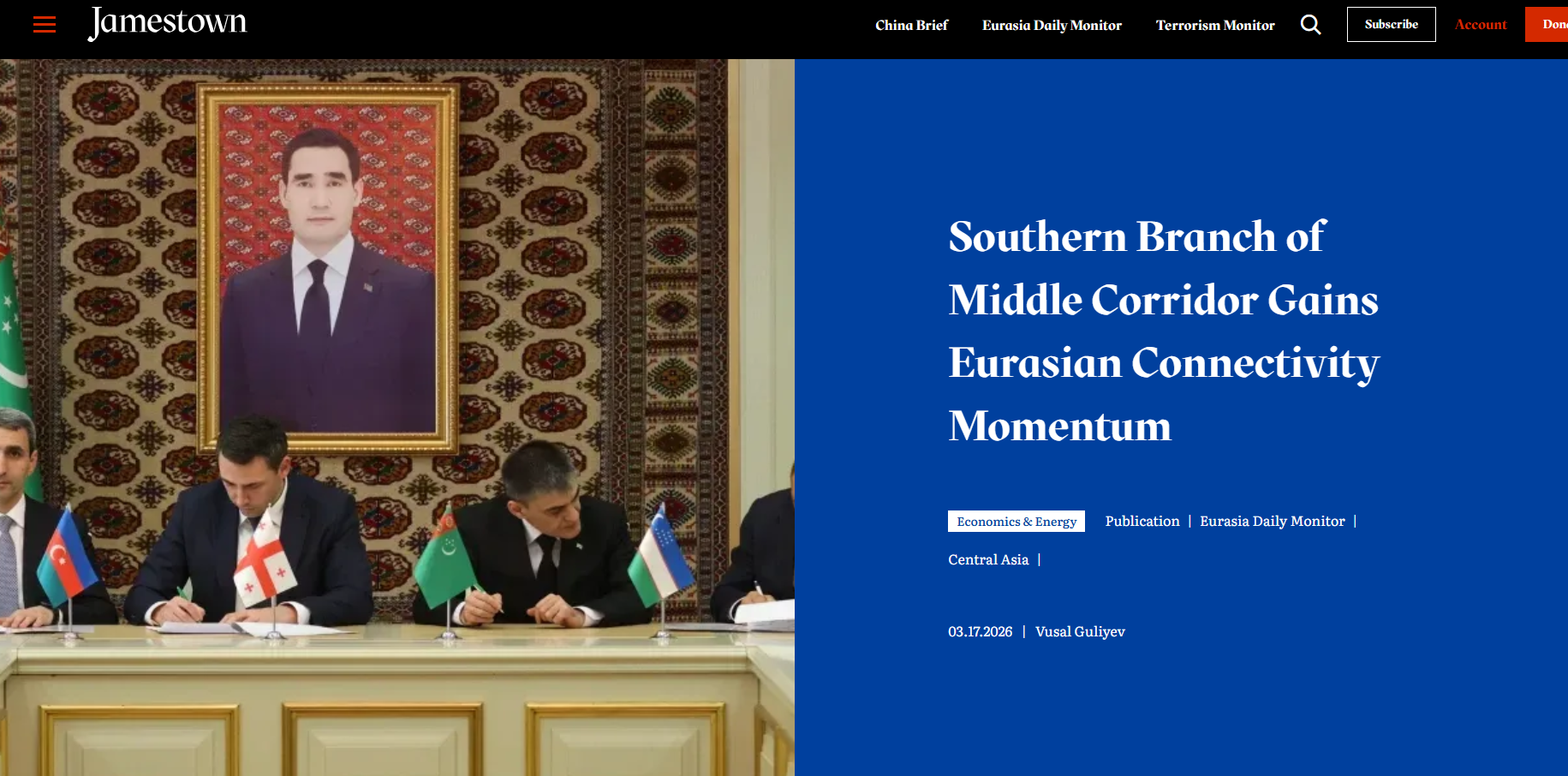
The gathering in Ashgabat reflected the growing recognition among regional players that deeper institutional coordination is essential to transform the corridor from a conceptual route into a fully integrated logistics network. Azerbaijan Railways Chairman Rovshan Rustamov, Turkmenistan Minister of Railway Transport Mammed Akmammedov, Uzbekistan Railways Board Chairman Zufar Narzullayev, and Georgian Railways Director General Lasha Abashidze attended the meeting. Their discussions focused on increasing freight volumes, strengthening operational coordination among national railway systems, and enhancing the Middle Corridor’s competitiveness as a multimodal Eurasian transport route linking Central Asia, the South Caucasus, and European markets (Embassy of Azerbaijan to Turkmenistan, February 10).
Uzbekistan’s expanding role in the corridor emerged as a particularly significant development. The country’s deepening integration into the Middle Corridor marks an important expansion of the route beyond its original core members. As the most populous country in Central Asia and one of the region’s fastest-growing economies, Uzbekistan has increasingly prioritized international connectivity and transit infrastructure (see EDM, April 8, July 7, October 16, November 12, 2025, January 27; The Times of Central Asia, October 15, 2025). Integrating its railway system into the Trans-Caspian trade network allowed Uzbekistan to gain more direct access to the South Caucasus, Türkiye, and European markets while strengthening the southern branch of the corridor (ADY Express, February 9).
In October 2025, a new multimodal freight corridor was launched linking the PRC with Kyrgyzstan, Uzbekistan, and Turkmenistan before reaching the Caspian Sea and continuing westward through Azerbaijan via the Baku–Tbilisi–Kars railway toward Europe. The first pilot shipment departed from Kashgar, Xinjiang Uyghur Autonomous Region, successfully transiting Kyrgyzstan and Uzbekistan before reaching Turkmenistan and the Caspian maritime segment, from which it continued westward via Azerbaijan (Global Times, October 23, 2025). The shipment highlighted the growing viability of a new east–west logistics chain linking Central Asia with the Caspian and European markets. More broadly, the initiative strengthens regional connectivity and reinforces the Middle Corridor’s infrastructure, gradually repositioning Central Asia from a historically landlocked region into an increasingly interconnected transit hub (see EDM, December 4, 2025).
The Ashgabat meeting also built upon earlier efforts to deepen coordination among participating states. In August 2025, Azerbaijan, Turkmenistan, and Uzbekistan signed a Memorandum of Understanding in Turkmenbashi to improve coordination across the Caspian segment of the corridor (EU Reporter, August 23, 2025). The agreement laid the institutional foundation for closer operational alignment among participating countries and established a framework for enhancing logistics efficiency along the route.
Following the discussions in Ashgabat, the participating railway authorities signed a joint protocol outlining measures to expand cargo transportation and modernize the corridor’s operational framework (Trend News Agency, February 10). More specifically, the agreement emphasizes the digital transformation of railway operations, enhanced data exchange among railway administrations, and a comprehensive diagnostic assessment of corridor performance to identify bottlenecks and optimize transit efficiency. These measures are expected to reduce delays and improve the predictability of cargo shipments along the Middle Corridor (Report News Agency, February 10).
Parallel to these institutional initiatives, major infrastructure projects are also reshaping the corridor’s strategic outlook. Uzbekistan’s integration into the Middle Corridor aligns closely with broader transport developments across Central Asia. Among the most significant projects shaping the corridor’s future is the China–Kyrgyzstan–Uzbekistan railway, a 523-kilometer (325-mile) line currently under construction and expected to be completed by 2028 (see EDM, July 17, December 4, 2025, January 27). Once operational, the railway will shorten the transit distance between the PRC and Europe by more than 1,000 kilometers (621 miles), creating a faster and more efficient overland trade link between East Asia and European markets (The Times of Central Asia, December 22, 2025; see EDM, January 27).
As cargo flows expand and operational efficiency improves, the south-central, Caspian, and western segments of the corridor are gaining increasing strategic significance. Turkmenistan’s, Azerbaijan’s, and Georgia’s roles facilitate transcontinental connectivity. Turkmenistan occupies a crucial position on the eastern shores of the Caspian Sea, serving as a key gateway linking Central Asian rail networks with maritime routes across the Caspian (Organisation for Economic Co-operation and Development, November 24, 2025). Through infrastructure such as the Turkmenbashi International Seaport and its expanding railway connections with Uzbekistan and Kazakhstan, Turkmenistan enables cargo from Central Asia and the western end of the PRC to reach the Caspian maritime corridor. In doing so, the country plays an essential role in channeling freight toward Azerbaijan and the South Caucasus, further consolidating the southern branch of the Middle Corridor (Trend News Agency, September 13, 2025).
Azerbaijan functions as the primary transit hub connecting Central Asia with the South Caucasus and onward to European markets. Situated on the western shores of the Caspian Sea, Azerbaijan provides a maritime and logistical bridge between Central Asian producers and the overland rail networks extending toward Europe (Caspian-Alpine Society, February 4, 2025). The Port of Baku, together with Azerbaijan’s modernized railway infrastructure, enables the efficient transfer of cargo arriving from Kazakhstan and Turkmenistan across the Caspian Sea before continuing westward (see EDM, April 23, 2025). Furthermore, intraregional connectivity initiatives such as the Trump Route for International Peace and Prosperity (TRIPP)/Zangezur Corridor are poised to strengthen the Middle Corridor’s overall resilience and diversification (AIR Center, February 4).
Georgia represents the corridor’s principal gateway to the Black Sea and European markets. The country facilitates the onward movement of goods toward Türkiye and Europe. Intraregional infrastructure projects, such as the Baku–Tbilisi–Kars railway, together with Georgia’s Black Sea ports—particularly Poti and Batumi—play a vital role in facilitating the efficient transit of freight across the region (Middle East Institute, March 2021; see EDM, April 22, November 20, 2025, January 29; The World Bank, accessed March 16). As Central Asian states deepen their engagement with the Middle Corridor, the complementary roles of Turkmenistan as the Caspian eastern gateway, Azerbaijan as the Caspian transit hub, and Georgia’s access to the Black Sea are likely to further enhance the corridor’s importance within Eurasian trade networks.
The Middle Corridor is gradually evolving beyond a conventional freight route into a broader platform for Eurasian connectivity. Alongside rising cargo volumes, the corridor is increasingly linked to energy infrastructure projects, digital connectivity initiatives, and efforts to develop more sustainable and climate-friendly supply chains (EU Reporter, December 26, 2025). Deeper regional integration along the southern segment of the route represents a crucial step toward consolidating the Middle Corridor as a major transcontinental transportation artery. Continued infrastructure development and digital modernization are expected to further the corridor’s role in shaping the future architecture of Eurasian trade and regional connectivity.