Is the unipolar world dead?
Competing groups – The SCO (Shanghai Cooperation Organisation, BRICS (Brazil-Russia-India-China-South Africa), and OTS (Organisation of Turkic States) – are becoming more influential and increasingly optimistic about their prospects. Of these, only the OTS has sought to maintain a balanced position between the West and East (Russia, China) without becoming embroiled in the global conflict unleashed by Russia’s full-scale invasion of Ukraine on February 24, 2022. Russia and China have sought to transform the SCO and BRICS into anti-Western blocs.

Maybe it is too early to deliver a requiem mass, but the unipolar world is certainly in stagnation. Two key events shaped the acceleration of this stagnation. The first was the rise of Azerbaijan in the South Caucasus as an energy superpower after its military victory over Armenia in the 2020 Second Karabakh War and signing in June 2021 of a strategic partnership with Türkiye (Shusha Declaration). The second was Russia’s full-scale invasion of Ukraine which has become a proxy war between the West and East (Russia-China-Iran-North Korea) played out in Ukraine. Nurbek Bekmurzaev wrote that ‘The challenges and opportunities presented by Russia’s war against Ukraine are the main factors driving the rapidly growing cooperation between Central Asia and Azerbaijan.’
The US under populist nationalist president Donald Trump is no longer a champion of Western values, does not see itself as the leader of the free world and does not seek to spread democracy around the world. Trump’s isolationism is not his alone; after all President Barack Obama was also disinterested in a robust foreign policy agenda and spreading democracy. All 3 US presidents, Republicans and Democrats, – Trump, Obama and Joe Biden – have opposed NATO enlargement.
The European Union (EU) continues to view itself as embodying European and democratic values. Nevertheless, the EU was never established to be a military and security actor – irrespective of what French President Emmanuel Macron would like it to be. The EU was also cautious about enlarging into Eurasia and only offered Ukraine, Moldova and Georgia candidate status after Russia’s full-scale invasion; Georgia’s has since been suspended because of democratic backsliding.
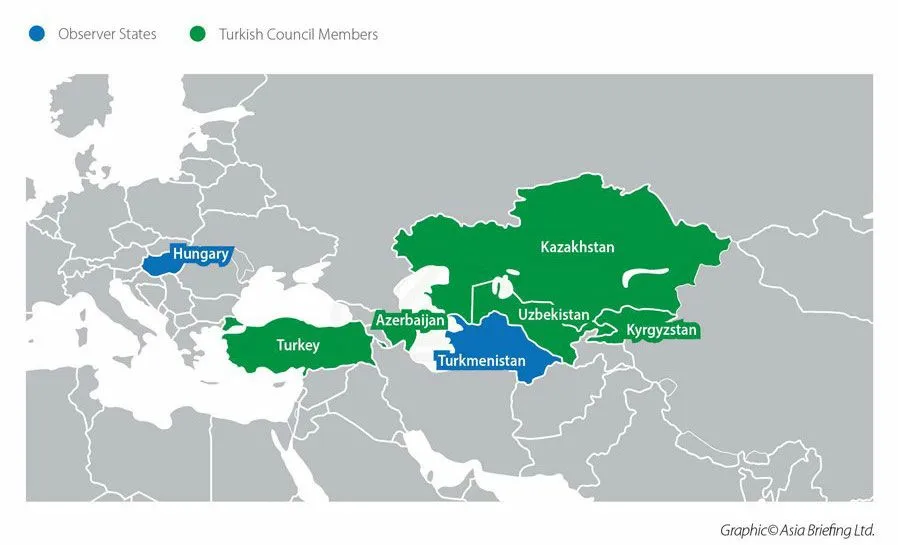
Why then is the OTS different? The OTS is composed of five Turkic speaking members – Azerbaijan, Türkiye, Kazakhstan, Kyrgyzstan, and Uzbekistan – with two observers – isolationist Turkmenistan, EU and NATO member Hungary and Northern Cyprus. Tajikistan, although geographically located in Central Asia is Farsi speaking.
Established nearly two decades ago in 2009 in the Azerbaijani region of Nakhchivan, the OTS has grown from a ‘consultative mechanism to a robust international entity with geostrategic significance.’ The OTS has grown to include a Parliamentary Assembly, Turkic Academy (Astana, Kazakhstan), Turkic Cultural Foundation (Baku, Azerbaijan), Turkic Investment Fund (Istanbul), Turkic Chamber of Commerce and Industry (Istanbul), and Turkic Business Council (Istanbul).
Following the first cultural forum of the Turkic World in Shusha in October 20-23, the city became the cultural capital of OTS. Culturally, the OTS supports initiatives like TÜRKSOY, the Union of Turkish Universities, and the Turkic Academic Research Fund. These efforts aim to deepen educational and cultural ties, including the development of a common Latin alphabet and joint textbooks on Turkic history.
Unlike the SCO and BRICS, the OTS is united by culture and language beyond the state borders of its members. The past, present and potentially their future therefore unites its members through ethnic identity, language, culture, values and traditions. Similar unity has never existed in the SCO or BRICS; let alone Vladimir Putin’s Russian World where the Russian army is seeking to militarily force Ukraine to be part to the Russian World.
Unlike in Russian-led Eurasian structures, or the Russian and Chinse led SCO and BRICS, in the OTS Farid Shafiyev wrote, ‘each of them feel themselves as equal members, unlike political-military organizations dominated by the global powers as during the Cold War era.’ President Ilham Aliyev asked ‘should we bow down to those who do not want to accept us somewhere? Not at all, it will not happen! Our family is the Turkic world. We feel ourselves perfectly. We have brotherly relations with all member countries of the Organization of Turkic States.’ The OTS is a ‘large territory, with a big military force, economy, natural resources, and transportation routes’ and ‘we are peoples of the same family, of the same roots. Can there be a unity stronger than that? Of course not.’

(from left to right) Turkish and Azerbaijani Presidents Recep Tayyip Erdoğan and Ilham Aliyev at a recent OTS summit
In November 2021 and February 2024 at OTS summits, Azerbaijani President Ilham Aliyev described the Turkic World as ‘our family.’ In 2021-2023, following the Shusha Declaration, Aliyev paid 20 visits to OTS members and observers. Azerbaijan’s military victory ‘showcased the effectiveness of Turkic military cooperation and elevated the strategic importance of the organisation.’ The Shusha Declaration ‘served as a model for broader cooperation among Turkic states.’ In many ways the OTS became an extension of the Azerbaijani-Turkish partnership which set out a model for other Turkic states to build their partnerships who hold shared geopolitical, trade, energy and political interests.

The 2024 OTS Summit in Bishkek, Kyrgyzstan
Of the OTS members, Kazakhstan and Azerbaijan tower above the others because of their size and economic and energy clout. Azerbaijan-Kazakhstan have growing trade and energy ties, military cooperation and joint building of pipelines, electricity and fibre optic cables under the Caspian Sea. Uzbekistan though a late comer, is now catching up with economic and connectivity projects.
With the Northern Corridor no longer functional due to Russia’s war against Ukraine, the OTS has pursued the Middle Corridor as an alternative route enhancing trade between China and Europe through Central Asia and the South Caucasus – a modern-day Silk Road. ‘Historically, trade flowing from China to Europe via the Silk Road played an important role in enriching Turks and building powerful states’ and ‘The revival of the historical SilkRoad plays an important role in the revival of the Turkic world.’

The 4,500 mile (7,000 kilometres) Middle Corridor promotes trade, regional connectivity, transportation networks, infrastructure and investments. The Samarkand 2022 and Astana 2023 OTS summits laid out joint action plans for increasing connectivity by reducing trade barriers through the Baku-Tbilisi-Kars railway and in the East Zangezur Economic region of Azerbaijan.
With Russia distracted by its war against Ukraine and the US having closed its military bases in Central Asia following its withdrawal from Afghanistan, ‘Beijing has filled the vacuum – not only securing more resource deals with Central Asian nations but also engaging in a frenzy of infrastructure construction across the region to make sure China, whatever the geopolitical weather, can keep transporting g
The Northern Corridor is closed, and the Southern (maritime) Corridor could come under threat in the event of a conflict over Taiwan leading to a US blockade of the Strait of Malacca,
and therefore ‘China is now investing heavily in the long-neglected multi-modal trade route – across Kazakhstan and/or Kyrgyzstan and Uzbekistan by train, across the Caspian Sea to Azerbaijan, then through Turkey or Georgia to Western Europe.’ China is therefore an important supporter of the Middle Corridor, sometimes called ‘The New Silk Road’, with Beijing funding railways across Central Asia and investments in Caspian and Black Sea ports.
The Middle Corridor will increase the flow of Central Asian energy supplies to Europe bypassing Russia through which it is now impossible because of Ukrainian attacks on energy infrastructure. The strategic importance of five pipelines will be enhanced – TANAP (Trans Anatolian Gas Pipeline Project), Southern Gas Corridor, Baku-Tbilisi-Ceyhan, Balu-Tbilisi-Erzurum, and Trans Adriaric Pipeline Project.
OTS members balance between two big hegemons, one declining – Russia – and another rising – China. Central Asia, dominated by Russia since the late nineteenth century, has seen the rise of Chinese influence and China has seized the opportunity to expand its influence. Practically the entire Russian army is preoccupied fighting against Ukraine while Russia lacks the financial resources of China to maintain its economic influence.

The growth of extremism, terrorism and war in Eurasia has prompted greater cooperation in security and defence between OTS members in their balancing act between Russia, China and the West. The 2023 OTS summit in Astana, only a year after Russia launched its full-scale invasion of Ukraine, called for ‘closer cooperation in the field of defence industries and military collaboration.’ Aliyev told the 2023 OTS summit: ‘Regrettably, today, the norms of international law are being flagrantly violated across different parts of the world. Wars and bloody conflicts are inflamed. Under such circumstances, primarily, the countries’ defence capability becomes their main security guarantee. I believe that cooperation between the Member states in such spheres as security, defence, and defence industry must be ramped up.’
The 2020 Azerbaijani-Armenian and Russian-Ukrainian war since 2022 showed the importance of drones to modern warfare and Turkish drones are now being produced in Kazakhstan. The Turkish defence companies ASELSAN and ROKETSAN have production bases in Azerbaijan.
OTS members have supported the Azerbaijani-Armenia peace process. OTS has also backed Türkiye in its campaign against the PKK (Kurdish Workers Party), YPG (Peoples Protection Unit) and Gulenist terrorist group.
Unsurprisingly, the war in Ukraine has had a strategic impact on how OTS members view their future security. OTS members are staunch supporters of the sanctity of the territorial integrity of states and are critical – diplomatically – towards Russia’s blatant violation of Ukraine’s sovereignty and at the UN abstain in votes condemning Russia. The October 2025 OTS summit in Gabala, Azerbaijan was held under the slogan ‘Regional Peace and Security.’ The OTS summit followed the signing of a long-awaited peace agreement in the White House presided over by President Trump between Armenia and Azerbaijan.
Kazakhstan stands out for its vocal opposition to Russia’s invasion. President Tokayev publicly rejected Russia’s territorial claims and supported Ukraine. Kazakhstan is especially concerned because Russian nationalists harbour territorial claims to its northern region. The 2023 OTS extraordinary summit in Ankara laid out its support for the inviolability of the territorial integrity of states, respect for the sovereignty of states and inviolability of internationally recognised borders.
The rise of the OTS has been largely ignored by a Europe preoccupied by internal crises, managing relations with Trump-led US and confrontation with Russia. This is mistaken as Turkic unity is growing and, through the Middle Corridor, a strategic partner in expanding trade with six countries and a large population, diversification away from Russian energy and managing relations with China.
The OTS seeks to balance between two declining hegemons– Russia and the US – and a rising hegemon – China. The EU, which is yet to match its potentially large military power with its economic clout, could potentially be an important partner for the OTS.