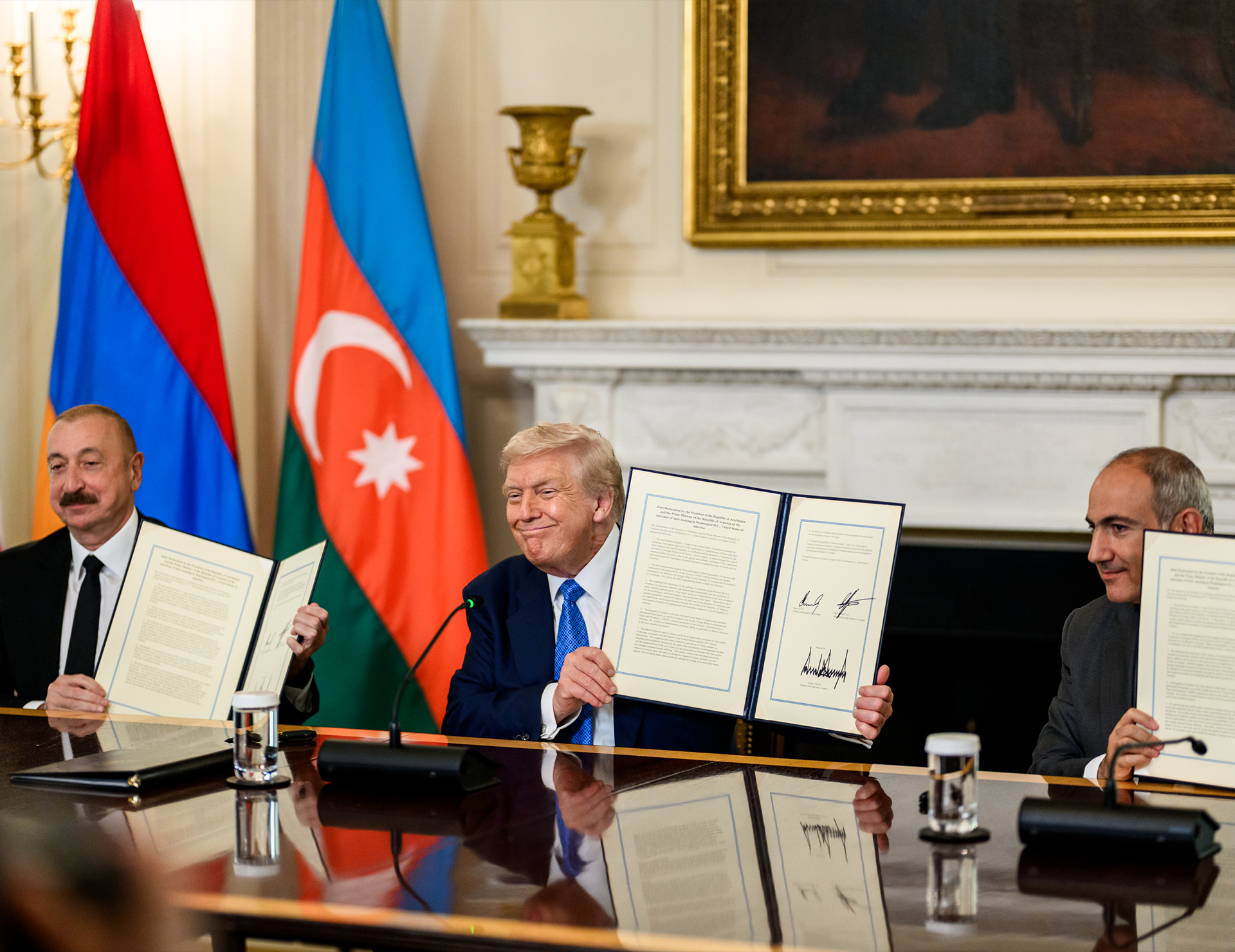
President Ilham Aliyev’s recent interviews with domestic television channels provide a conceptual political analysis that unveils the structural logic and institutional character of U.S.–Azerbaijan relations. The President presents the 907th amendment not as an isolated episode or the product of individual relationships, but through the prism of international system mechanisms, the hierarchy of great power interests, and how weaker actors are easily transformed into objects of political manipulation.
Aliyev’s statements reaffirm a core reality in international relations: justice often derives not from formal legal norms, but from institutional memory and the calculus of political utility. The 907th amendment, passed by the U.S. Congress, reflects the political configuration of a specific historical period while simultaneously symbolizing Washington’s long-standing selective approach toward the South Caucasus. In this sense, the President’s position exposes how injustice can be normalized and maintained within international institutional agendas for years as a seemingly routine decision.
A notable feature of Aliyev’s approach is the avoidance of an emotional narrative. The focus is not on “who is right?” but on the more fundamental question: “Why does the international system operate this way?” As the President emphasizes, Azerbaijan’s early post-Soviet role as a functional partner—whether as a transit corridor, an element of energy security, or a military-logistical partner—demonstrates that bilateral relations were based on instrumental utility rather than intrinsic value.
During a period when Azerbaijan faced existential security threats, humanitarian crises, and occupation, the country was paradoxically punished, while the aggressor enjoyed political protection. Aliyev’s analysis exposes the roots of this paradox.
As the President notes, the 907th amendment was formally an independent decision of the U.S. Congress. However, international practice shows that such decisions rarely emerge purely from neutral institutional mechanisms. Rather, administrative indifference, information asymmetry, and powerful lobbying operated together as decisive factors.
Reducing the issue to Armenian lobbying alone would be a politically simplistic explanation. The real problem was Azerbaijan’s inability, at that stage, to act as a fully fledged subject defending its interests systematically in international institutions. Consequently, a political vacuum emerged, which was swiftly filled by more organized actors with institutional leverage. Politically, this phenomenon aligns with the concept of the “invisibility of weak states in international institutions”: when a state’s legal sovereignty is not matched by real political weight, it can be easily marginalized in decision-making processes. The 907th amendment was the product of precisely such a scenario: the state under occupation and facing a humanitarian catastrophe became a passive subject, while the aggressor actively shaped the narrative.
Another crucial point is the stark contradiction between the historical-political context of the amendment and objective reality. Aliyev frames this contrast precisely and unemotionally: “At that time, our territories were already under occupation… The Azerbaijani population was subjected to the Khojaly genocide by the Armenian state.”
This statement underscores that, from the perspective of international law—territorial integrity, state sovereignty, and protection of civilian populations—the amendment punished the victim rather than the aggressor. If the formal rationale for the 907th amendment was the “blockade of Armenia,” the claim fails both geopolitically and factually. Armenia maintained open borders with Georgia and Iran, and the Turkey–Armenia border was not yet closed, rendering the “blockade” argument a normative myth. In this context, the amendment ceases to function as a legal instrument and becomes a tool of lobby-driven political influence.
Politically, the 907th amendment exemplifies the selective application of international justice: the gap between declared principles of international law and the substance of real-world decisions is stark. Such discrepancies are particularly visible in the treatment of weak or transitional states.
President Aliyev’s explicit mention of Joe Biden is not personal polemic or political preference but a revelation of political continuity and institutional patterns. His statements demonstrate that U.S. administrations, despite stylistic differences, have maintained a consistent line regarding Azerbaijan, reflecting long-term strategic calculations rather than situational decisions. The Obama–Biden and subsequent Biden–Blinken administrations’ approaches show that U.S. policy was guided by enduring institutional and ideological positions in regional matters.
This highlights the structural contradiction between Washington’s normative discourse on human rights, democracy, and international justice and its practical policy tools. In Azerbaijan’s case, the state that suffered occupation, ethnic cleansing, and humanitarian catastrophe was paradoxically positioned as the “punished party.”
The temporary suspension of the 907th amendment following the September 11, 2001 attacks confirms the pragmatic, interest-based character of U.S. policy. Azerbaijan’s strategic significance in the Afghan mission temporarily altered Washington’s priorities, suspending the amendment as transit routes, logistics, and regional stability became paramount. Once the mission concluded, the amendment’s reactivation revealed the instrumental logic underpinning U.S. regional policy.
Aliyev’s pointed observation—“The day will come when we will be needed again. But do not knock on our door then”—encapsulates Azerbaijan’s transformation. It reflects the country’s shift from a weak, dependent actor seeking assistance to a regional power confident in its energy resources, transport-logistics infrastructure, and security architecture.
From a political-analytical perspective, this represents a clear transition from asymmetric dependency to a model of symmetric interests. Whereas Azerbaijan was once a functional asset for the United States, it now operates as a decisive actor in regional processes. Aliyev’s message is clear: partnerships cannot be limited to episodic convenience; history, political memory, and mutual respect must underpin international cooperation.
Changes observed during the Trump administration further illustrate that U.S.–Azerbaijan relations are driven by strategic realism, not ideological proximity or personal affinity. During this period, Washington’s South Caucasus policy was structured around power balance, energy security, and geostrategic communication lines, enabling a shift toward pragmatic, mutually beneficial engagement.
Ultimately, as Aliyev emphasizes, the 907th amendment has lost all practical, legal, and moral justification. Constructed on artificial arguments during a conflict, it has become obsolete in the post-conflict reality. Azerbaijan has emerged as a central node in communication corridors, transport routes, and energy flows, while Armenia’s transit capacities are effectively conditioned by Azerbaijani territory.
The 907th amendment, once an instrument of influence, now stands as a symbolic relic of institutional legacy, offering neither additional leverage to Washington nor strategic utility in regional dynamics. On the contrary, it serves as a cautionary emblem, undermining U.S. claims to justice and balanced action in the region.
Shabnam ZEYNALOVA
Expert of the Baku Political Scientists’ Club (Center)
PhD in Poltical Science, Associate Profesor