Executive Summary:
- U.S. Vice President J.D. Vance’s February 9–11 visit to Armenia and Azerbaijan marked Washington’s most consequential engagement in the South Caucasus since the August 2025 peace summit.
- In Yerevan, Vance advanced a landmark U.S.–Armenia nuclear cooperation deal, backed AI technology and defense sales, and promoted TRIPP connectivity. In Baku, he signed a Strategic Partnership Charter expanding energy, transit, and security cooperation.
- For Armenia and Azerbaijan, the visit underscored Washington’s commitment to sustained regional engagement, reinforcing the United States as a key external partner in post-conflict normalization and economic integration.
U.S. Vice President J.D. Vance’s February 9–11 visit to Armenia and Azerbaijan marked the most consequential U.S. engagement with the South Caucasus since the August 2025 Washington Peace Summit (Prime Minister of Armenia, February 9; President of Azerbaijan, February 10). The trip’s focus included nuclear energy, artificial intelligence (AI), connectivity infrastructure, and strategic partnership building. It marked the second visit by a sitting U.S. vice president to Azerbaijan—after former U.S. Vice President Dick Cheney traveled to Baku in 2008—and the first such visit to Armenia, signaling a deeper phase of U.S. involvement in the region (see EDM, September 9, 2008). Coming ahead of Armenia’s June 2026 parliamentary elections and six months after both countries’ foreign ministers initialed a draft of an Armenia–Azerbaijan peace deal at the White House in August 2025, the visit blended political signaling with long-term economic and technological commitments (see EDM, August 12, September 9, October 15, 2025).
In Yerevan, Vance moved beyond routine diplomatic language. He said, “I know [Armenian Prime Minister Nikol Pashinyan] has an election coming up … to the extent my endorsement means anything, he certainly has it,” (Prime Minister of Armenia, February 9). The statement resonated with some regional commentators who assert that continuity in Armenia’s leadership will facilitate the fragile peace with Azerbaijan, advancing post-conflict normalization, and maintaining Armenia on a pro-Western track.
Development of the Trump Route for International Peace and Prosperity (TRIPP), also known as the Zangezur Corridor, was a priority of the visit. The route links mainland Azerbaijan to its Nakhchivan exclave through Armenian territory. The United States plans to lease the 27.3-mile route for up to 99 years with exclusive development rights (see EDM, February 12). The project aims to transform a former subject of conflict between Armenia and Azerbaijan into a channel for commerce and long-term, mutually beneficial interdependence.
The most structurally significant development of Vance’s visit to Yerevan was the completion of negotiations on a bilateral U.S.–Armenia agreement on nuclear energy cooperation. Vance stated that the framework could pave the way for “$5 billion in U.S. exports, plus an additional $4 billion in support through fuel and maintenance contracts” (Prime Minister of Armenia, February 9). Armenian media, however, initially reported the figure as $5 billion in “investment,” rather than exports (OC Media, February 10). The mistranslation created short-lived public confusion about the scale and nature of the U.S. commitment. While the word “investment” suggested a direct capital inflow into Armenia, Vance’s formulation referred to export contracts, namely, the sale of U.S. nuclear technology, equipment, and related services.
The difference may be less dramatic than the initial confusion implied. Large-scale nuclear export agreements typically generate extended financial, technical, and regulatory engagement. Fuel supply chains, maintenance contracts, safety oversight, and workforce training embed long-term institutional linkages. Even if structured as export revenue for U.S. firms, the arrangement would still reshape Armenia’s energy architecture and anchor it within Western technological systems.
The importance of this nuclear energy agreement explains the sharp reaction from Russia’s Ministry of Foreign Affairs. Russian Foreign Ministry spokesperson Maria Zakharova questioned both the technological and financial underpinnings of the proposed project (Golos Armenii, February 12). She claimed that the small modular reactors (SMRs) promoted by Washington “do not exist anywhere on U.S. territory—they do not exist anywhere in principle; they exist on paper,” and said that no concrete technical details had been publicly presented (Golos Armenii, February 12).
Zakharova also challenged Armenian media portrayals of the agreement as an unprecedented U.S. investment. She claimed that, according to information available to Moscow, the arrangement does not involve direct U.S. capital injections but rather a scheme under which the Armenian side would ultimately bear the financial burden (Golos Armenii, February 12). She said that Russia has been Armenia’s long-standing partner in the nuclear sector, and that Moscow has supported the operation and servicing of the Metsamor nuclear plant for decades and is currently working with Yerevan on extending its lifespan until 2036. Russian officials more broadly framed expanding Western engagement in the South Caucasus as Washington’s attempt to strengthen its geopolitical influence in a region marked by instability (Sputnik Armenia, February 12).
U.S.–Russia nuclear energy cooperation may help provide a stable energy foundation required for Armenia’s next phase of technological development. Prior to the visit, Armenia secured access to advanced NVIDIA chips and announced plans for a major AI data center (Eurasianet, November 21, 2025). Reliable baseload electricity—potentially supplied by SMRs from the United States—would be essential to sustaining such high-performance computing infrastructure. Vance said that semiconductor exports would enable Armenia’s technological modernization (Prime Minister of Armenia, February 9). Together, the nuclear and AI initiatives suggest a coordinated effort to reposition Armenia within advanced technological value chains.
The visit also expanded the security dimension of U.S.–Armenian relations. Armenia confirmed a planned acquisition of approximately $11 million worth of V-BAT unmanned aerial systems under the U.S. Foreign Military Sales program (Prime Minister of Armenia, February 9). Vance framed the transaction as preventative, stating that “the best way to ensure that you have peace is to establish real deterrence” (Prime Minister of Armenia, February 9). Vance stated that these systems would strengthen Armenia’s surveillance and reconnaissance capacity along sensitive frontiers. While modest in scale relative to large weapons platforms, the sale represents the first major U.S. defense technology transfer to Armenia—particularly relevant given Yerevan’s traditional reliance on Russia for military equipment—and institutionalizes defense ties that were previously limited.
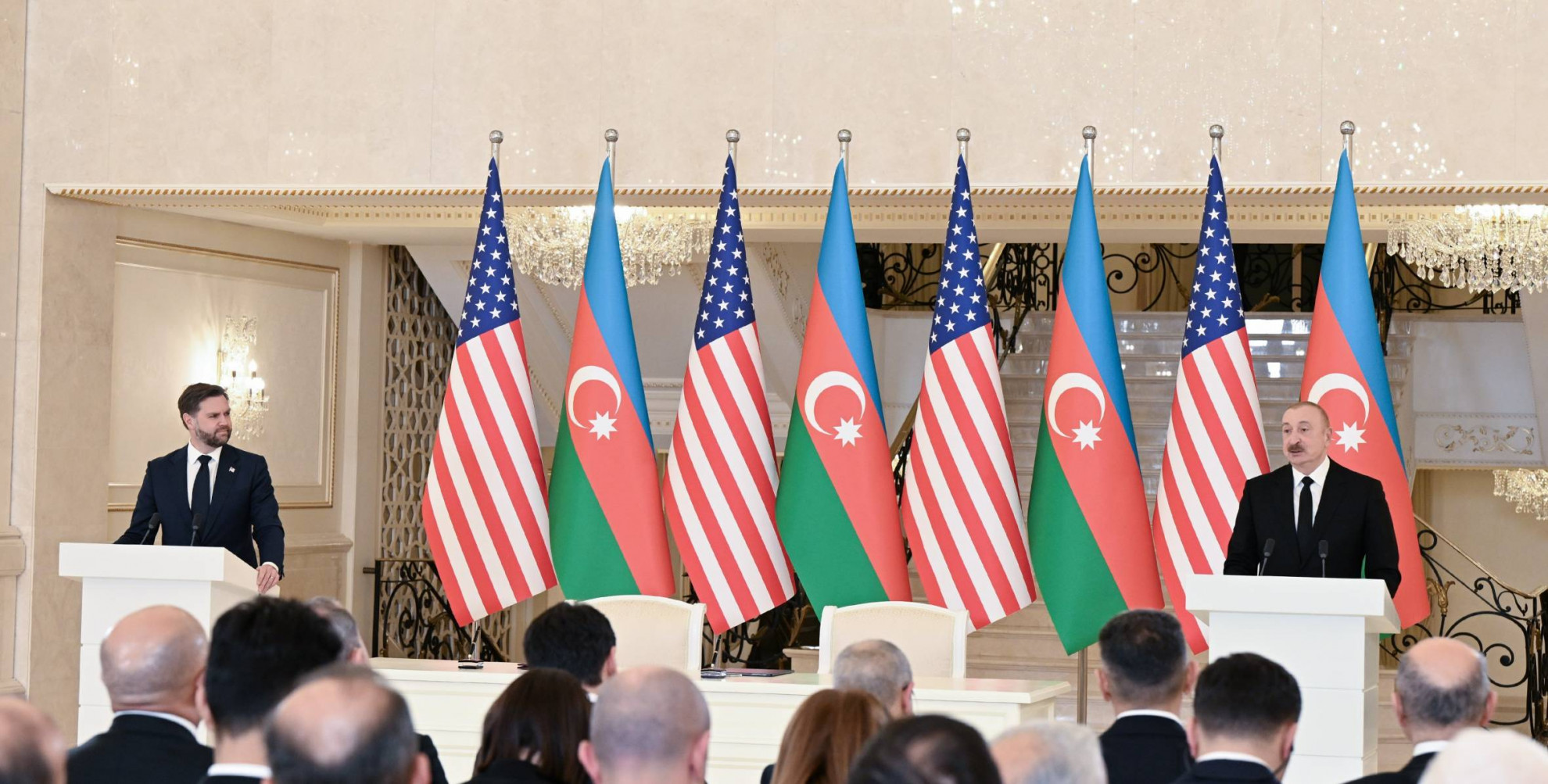
In Baku, Vance and Azerbaijani President Ilham Aliyev signed a Charter on Strategic Partnership. This document elevated bilateral ties across connectivity, energy, digital infrastructure, and security cooperation (President of Azerbaijan, February 10). Aliyev described the agreement as opening “an absolutely new phase” in relations, signaling that cooperation would move beyond episodic engagement toward institutionalized coordination.
Vance characterized Azerbaijan as a “very, very, very important partnership and friendship for the United States of America,” referencing its past contributions to international security efforts, including in Afghanistan (President of Azerbaijan, February 10). The charter formalizes cooperation in areas ranging from energy transit and digital connectivity to defense dialogue and maritime security (President of Azerbaijan, February 10). It reflects international recognition of the South Caucasus’ geographic centrality along east–west trade corridors and its growing importance within the broader Middle Corridor, also known as the Trans-Caspian International Transport Route (TITR).
Connectivity remained central to discussions between Vance and Aliyev. Aliyev emphasized that the TITR would provide “a very reliable, safe, and large-scale transportation corridor that will connect Asia with Europe” (President of Azerbaijan, February 10). He also noted that Azerbaijan has lifted transit restrictions and begun supplying oil products to Armenia—practical steps that signal economic normalization alongside political agreements. These developments suggest that Baku sees connectivity not only as a commercial opportunity but as a mechanism for consolidating post-conflict stability.
Commentators in Baku and Yerevan see Vance’s visit as an indication that Washington intends to remain engaged in the South Caucasus and in shaping the region’s economic and political structures as rapprochement moves forward. Regional media is emphasizing the trip’s focus on advancing the Armenia–Azerbaijan peace process, positioning Washington as a unifying actor in the region.
https://jamestown.org/baku-and-yerevan-view-vances-visit-as-expansion-of-u-s-engagement/