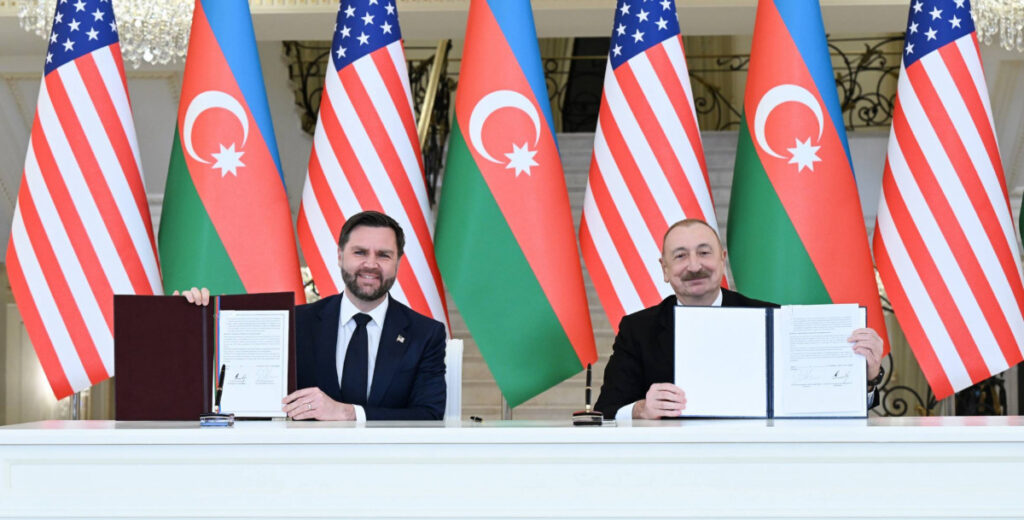
The joint press statements delivered by U.S. Vice President James David Vance and President Ilham Aliyev mark a qualitatively new phase in U.S.–Azerbaijan relations. Viewed through a political-analytical lens, these statements reveal not merely diplomatic goodwill, but the political coding of a strategic recalibration in Washington’s approach to the South Caucasus. Vance’s assertion that the United States seeks “closer ties” and a “stronger partnership” with Azerbaijan reflects an evolving regional doctrine shaped by shifting global power configurations.
What distinguishes this rhetoric from earlier diplomatic formulations is its functional grounding. The partnership is justified through tangible strategic outcomes: peace, access to markets, conflict prevention, and the creation of a cooperative regional environment. This framing invites a fundamental analytical question: Does Washington now perceive Azerbaijan as a partner united by shared values, or as a strategic actor fulfilling specific geopolitical functions?
The available evidence strongly suggests the latter. The emerging model of U.S.–Azerbaijan engagement aligns with a strategic functional partnership, rather than a normative or ideological alliance. Vice President Vance’s remark—“This is a goal set by the President of the United States”—underscores that bilateral relations are no longer driven by situational diplomacy or personal rapport, but are embedded within institutional decision-making and long-term strategic planning.
Azerbaijan’s contemporary political positioning is particularly noteworthy. It is no longer framed solely as an energy exporter or a transit hub, but as an active producer of regional stability. Through the promotion of a peace agenda, the facilitation of post-conflict platforms, and initiatives aimed at regional economic integration, Baku articulates a security concept that extends beyond territorial defense toward systemic regional equilibrium.
From Washington’s perspective, this role carries significant strategic value. The United States is increasingly shifting away from direct intervention toward a model of regional responsibility-sharing, whereby reliable local actors shoulder the burden of maintaining stability. Azerbaijan is being positioned as one such actor—capable, predictable, and strategically aligned in functional terms.
President Ilham Aliyev’s statement that U.S.–Azerbaijan relations have entered a “completely new phase” reinforces the reciprocal nature of this transformation. The phrase “new phase” does not denote a tactical adjustment, but rather a structural reconfiguration of bilateral relations. Historically characterized by fluctuation and episodic tension, the relationship is evolving into a multidimensional, interest-based cooperation model.
In earlier periods, instability in U.S.–Azerbaijan relations stemmed largely from divergent strategic lenses. Washington approached the South Caucasus primarily through a normative framework—democratic transformation and conflict management—while Baku prioritized sovereignty, territorial integrity, and energy security through a pragmatic policy calculus.
The current convergence is driven by the elevation of security, counterterrorism, and energy security to the forefront of bilateral engagement. These domains transcend traditional bilateral diplomacy and are now embedded within the architecture of global security. Azerbaijan’s integration into this architecture signals its recognition as a functional global partner, not merely a regional stakeholder.
This development leads to a more complex analytical inquiry: Can the deepening U.S.–Azerbaijan partnership serve as a foundation for sustainable peace in the region, or does it primarily function as an instrument for recalibrating geopolitical balances? In contemporary international relations, peace is no longer understood as the absence of conflict, but as managed stability—a product of strategic calculation, power equilibrium, and institutional resilience.
Vice President Vance’s statement that “where there was once only struggle and conflict, peace will emerge” carries normative optimism. Yet analytically, it points toward a reconfiguration of regional power balances. Peace, in this context, is not an idealized end state but a stability framework aligning major-power interests with regional capacities, minimizing escalation risks and security vacuums.
The U.S. emphasis on Azerbaijan’s stabilizing role reflects Washington’s intent to reduce uncontrolled escalation while minimizing the costs of direct involvement. Azerbaijan is thus positioned as both a carrier and guarantor of stability. The objective is not short-term calm, but a predictable long-term environment that secures energy flows, communication corridors, and political equilibrium.
The joint emphasis by President Donald Trump and President Ilham Aliyev on building “stronger and better relations” signals an ambition to co-design a strategic future, rather than merely manage the present. Energy security remains central—not only as an economic asset, but as a geopolitical instrument. Complementing this are counterterrorism efforts and the protection of regional communication lines, which together reinforce Azerbaijan’s role as a geopolitical hub.
In an era marked by non-state actors, transnational terrorist networks, and hybrid threats, regional stability is increasingly challenged by factors beyond conventional warfare. Weakly governed spaces and unsecured transit routes create fertile ground for illicit networks. Securing energy pipelines, transport corridors, and logistics routes thus becomes a cornerstone of both regional and global security architectures.
The statements surrounding the recent U.S.–Azerbaijan engagement transcend diplomatic protocol and function as a political manifesto redefining Azerbaijan’s position within the international system in the post-conflict era. Bilateral relations are evolving toward a model grounded in coordinated interests and shared strategic functions.
Ultimately, the emerging U.S.–Azerbaijan partnership introduces new opportunities while shaping new geopolitical realities—realities that increasingly frame the South Caucasus as a platform for managed stability and strategic cooperation.
Shabnam ZEYNALOVA
Expert of the Baku Political Scientists’ Club (Center)
PhD in Poltical Science, Associate Professor