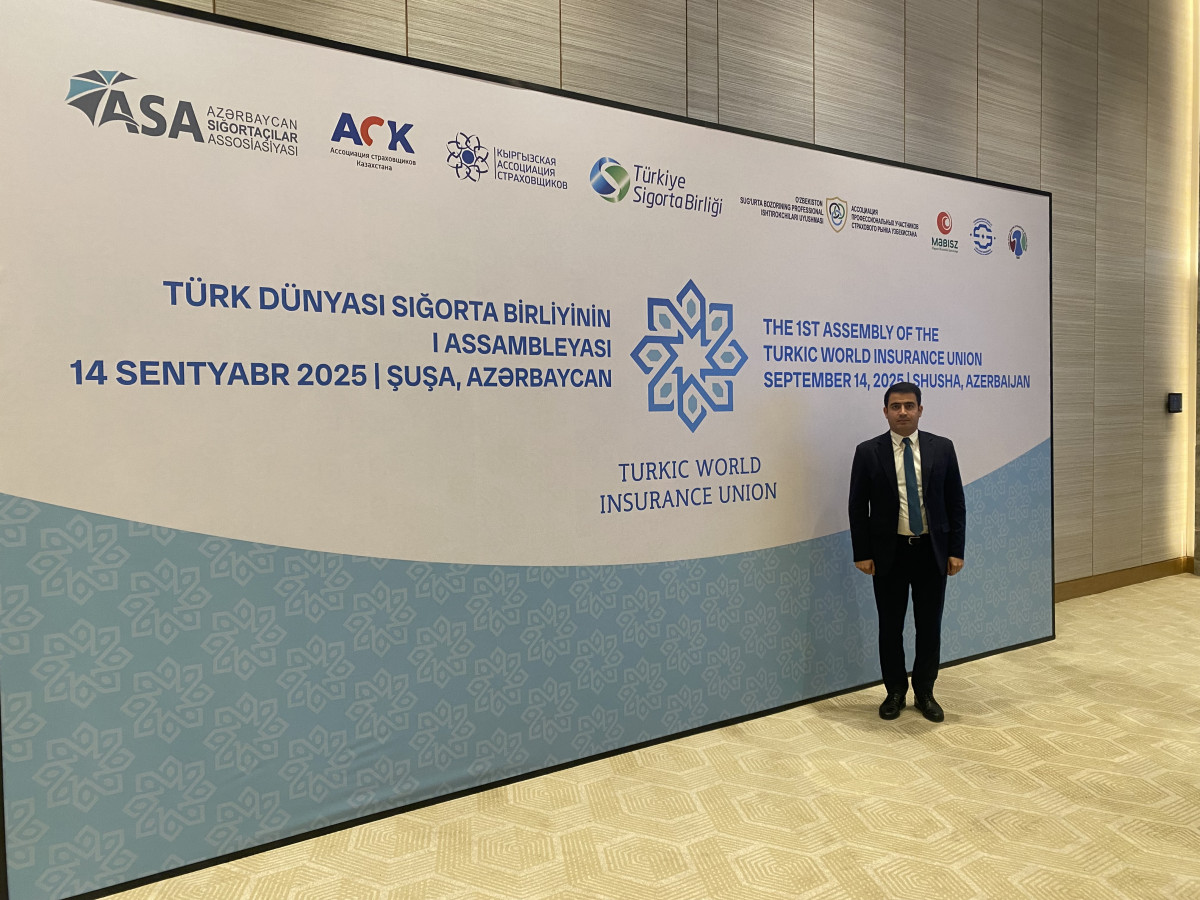
Latif Zeynalli, Head of the State Programs division at the Center for Analysis of Economic Reforms and Communication (CAERC), participated in the First Assembly of the Turkic World Insurance Union (TWIU) held in the city of Shusha.
The Assembly was organized with the support of the Central Bank of the Republic of Azerbaijan, by the initiative of the Azerbaijan Insurers Association, and with the participation of the Organization of Turkic States (OTS). The event brought together financial regulators and insurance associations from Azerbaijan, Kazakhstan, Kyrgyzstan, Türkiye, Uzbekistan, Hungary, Turkmenistan, and the Turkish Republic of Northern Cyprus, as well as representatives of the OTS. During the Assembly, insurance associations signed a “Proclamation Document” regarding the reformation of the TWIU in alignment with the principles of the OTS.
Commenting on the issues discussed during the Assembly, Latif Zeynalli, Head of the Department at CAERC, stated that this event not only serves as a preliminary platform for institutional cooperation aimed at the development of insurance markets among Turkic states but also elevates the strategic role of insurance institutions in ensuring economic security in the future.
Mr. Zeynalli emphasized that the modern insurance sector goes beyond the traditional role of loss compensation. It has evolved into a complex ecosystem that plays a strategic role in the early identification and management of risks and the assurance of socio-economic stability. In today’s context, digital transformation in the insurance industry is no longer an option but a necessity. Based on the latest data available for 2025 in the field of insurance technologies, the sector is undergoing rapid development and transformation. According to Future Market Insights, the global InsurTech industry is projected to reach $257.8 billion USD by the end of 2035, with an average annual growth rate of 26.1% between 2025 and 2035. Additionally, the number of active InsurTech startups globally has exceeded 3,400, compared to only 1,500 in 2018, indicating significant growth. Research by McKinsey experts suggests that the rapid progress of the insurance sector will further accelerate through automation, deep learning technologies, and the large-scale integration of external data ecosystems.
The CAERC representative also noted that, in 2025, Azerbaijan’s insurance sector continues to strengthen its strategic role within the economic system by maintaining positive dynamics in both premiums and claims. Specifically, for the period of January to July 2025, total insurance premiums amounted to 937.6 million AZN, while claims paid reached 529.3 million AZN. During this period, voluntary insurance accounted for 76% of total collected premiums, whereas compulsory insurance accounted for 24%, indicating the dominant position of the voluntary segment within the insurance market structure.
The upward trend observed in Azerbaijan’s insurance sector holds particular importance in the context of regional insurance integration. In this regard, the intersection of sectoral development directions with regional cooperation opportunities further underscores both the relevance and symbolic significance of the Assembly held in Shusha.
In conclusion, Latif Zeynalli highlighted that the event underscores the rapid development and innovation-driven transformation of Azerbaijan’s insurance sector. This platform can make a substantial contribution to institutionalizing experience-sharing among participating countries, forming common standards, implementing digital and innovative solutions, and enhancing resilience in the insurance market.