Key Takeaways
- The definition of a middle power has shifted from material size and military strength to behavioral traits like niche diplomacy, norm entrepreneurship, and proactive international engagement.
- Azerbaijan increasingly qualifies as a modern middle power through energy diplomacy, regional connectivity projects, hosting global events (COP29), and acting as a bridge-builder.
- This reflects a broader global trend: Influence today depends more on diplomatic agility and strategic specialization than on traditional raw power.
Analysis
The language of international politics is filled with familiar categories. States are routinely described as great powers, regional powers, small states, or middle powers, as if these labels were self-evident. Yet among these classifications, few concepts have generated as much scholarly debate as that of middle power. While the term has been widely used for decades, there is still no consensus on what actually makes a state a middle power. Is it a question of size, wealth and military capabilities, or should the concept instead be understood through the behavior and international role of states?
This debate has become increasingly relevant in the twenty-first century. The diffusion of power, the emergence of a more multipolar international system, and the growing importance of diplomacy, connectivity, technology and issue-specific leadership have challenged traditional understandings of international influence. States that do not possess the material capabilities of great powers are nevertheless increasingly shaping regional agendas, building international coalitions and providing solutions to transnational challenges. Consequently, the concept of the middle power deserves renewed attention.
The earliest studies approached middle powers primarily through their position within the international hierarchy. Among the most influential scholars, Carsten Holbraad viewed middle powers as states located between great powers and small states, but his understanding was not limited to simple quantitative indicators such as population or economic size. For Holbraad, middle powers possessed sufficient material and political capacity to preserve a degree of autonomy in international affairs and avoid excessive dependence on stronger actors. Their significance derived not only from their intermediate capabilities, but also from their ability to pursue independent foreign policies, maintain room for diplomatic maneuver, and contribute to stability within their regional or international environment. This approach provided an important foundation for later debates by linking middle-power status to both capability and conduct.
However, the material approach also revealed important limitations. States with similar economic and military resources frequently demonstrated very different levels of international influence. Some became highly respected diplomatic actors capable of shaping international agendas, while others remained largely passive participants in global affairs. Material capabilities alone could explain potential influence but not actual influence.
These shortcomings became particularly visible after the end of the Cold War. The emergence of globalization, increasing economic interdependence and the growing complexity of international governance created new opportunities for states that lacked great-power resources but possessed diplomatic flexibility and strategic vision. Rather than competing across every issue, such states increasingly concentrated their efforts on specific policy areas where they could exercise meaningful influence.
It was in this context that behavioral approaches fundamentally transformed middle power theory. Instead of asking what resources a state possesses, scholars increasingly asked how it behaves internationally.
Andrew Cooper became one of the leading proponents of this shift through his concept of niche diplomacy. According to Cooper, middle powers maximize their influence by concentrating diplomatic resources on carefully selected areas where they possess comparative advantages. Rather than attempting to rival great powers across the entire international agenda, they specialize in fields where sustained engagement can generate disproportionate influence. Niche diplomacy therefore represents a strategy of selective leadership, allowing states with limited resources to become indispensable actors within particular policy domains.
This behavioral perspective marked a decisive departure from earlier understandings. Influence was no longer measured primarily by aggregate capabilities but by diplomatic effectiveness. A state’s ability to identify strategic priorities, build international partnerships and consistently invest in selected policy areas became increasingly important than traditional indicators of power.
Andrew Carr further developed this argument by emphasizing that middle powers should be understood not as a fixed category but as states capable of influencing their strategic environment. Their defining characteristic lies in their capacity to shape regional or international outcomes despite lacking the comprehensive capabilities of great powers. Influence, in other words, is relational rather than absolute. A middle power is recognized not because of where it stands within the international hierarchy, but because of what it is able to achieve within it. Carr therefore bridges traditional capability-based approaches and behavioral theories by emphasizing influence rather than resources alone.
A complementary perspective is provided by Robert Cox, who viewed middle powers as stabilizing actors within the international system. According to Cox, they generally support multilateral institutions, promote cooperation and contribute to maintaining a rules-based international order. Their significance derives less from coercive capabilities than from their willingness to build consensus, strengthen international institutions and enhance the legitimacy of global governance. Middle powers, in this understanding, frequently function as facilitators rather than hegemons.
Marijke Breuning further enriches the behavioral understanding of middle powers by emphasizing that foreign policy itself provides one of the most reliable indicators of middle-power status. Rather than defining middle powers solely through structural characteristics or material capabilities, she argues that they should be understood through their patterns of external behavior and the roles they seek to play in international affairs. Beyond diplomatic activism and coalition-building, middle powers frequently act as norm entrepreneurs-states that promote new ideas, advocate international principles, and seek to shape regional or global agendas through persuasion rather than coercion. By initiating diplomatic platforms, advancing multilateral cooperation, and framing responses to emerging international challenges, they contribute to the evolution of international norms and practices despite lacking great-power capabilities.
Taken together, these theoretical approaches illustrate the evolution of middle power scholarship from structural and capability-based understandings toward behavioral and functional interpretations. Holbraad represents the classical perspective, emphasizing the combination of sufficient material capabilities and strategic autonomy that enables states to pursue relatively independent foreign policies. Cooper shifts the focus toward niche diplomacy and strategic specialization. Carr highlights the capacity to shape the international environment. Cox stresses multilateralism and institutional responsibility, while Breuning emphasizes foreign-policy behavior as the defining characteristic of middle powers. The concept has therefore evolved from a quantitative classification of states into a qualitative assessment of how states exercise influence.
This theoretical evolution reflects broader changes within international politics. Today’s international system is increasingly characterized by issue-specific leadership rather than universal dominance. Energy security, climate governance, digital technologies, transportation corridors and regional mediation all create opportunities for states that possess expertise, credibility and diplomatic initiative. Under these conditions, influence increasingly depends not on how much power states possess but on how effectively they mobilize the resources available to them.
Collectively, these perspectives suggest that contemporary middle powers should be evaluated through four interrelated dimensions. First, they develop strategic niches that allow them to exercise influence disproportionate to their material capabilities. Second, they pursue activist foreign policies, including coalition-building and norm entrepreneurship. Third, they seek to shape regional or international agendas rather than merely respond to them. Finally, they contribute to multilateral governance and international stability by acting as bridge-builders across competing geopolitical spaces. This behavioral framework provides a more comprehensive basis for assessing middle powers than traditional capability-based approaches and offers a useful lens through which to examine emerging cases such as Azerbaijan.
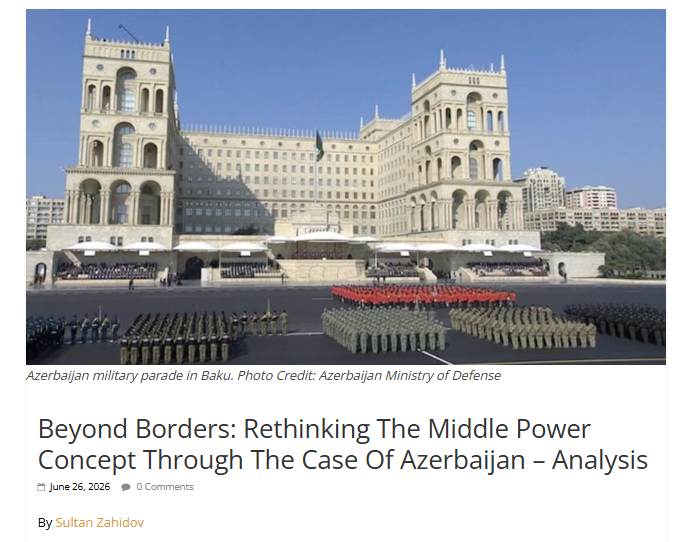
Viewed through this contemporary conceptual framework, Azerbaijan presents an increasingly compelling case. Judged exclusively by traditional material indicators, Azerbaijan would not necessarily fit the classical understanding of a middle power. Its population and geographic size remain considerably smaller than those of countries traditionally associated with the category. Yet the behavioral approaches developed over the past three decades suggest that such measurements no longer provide a sufficient basis for classification.
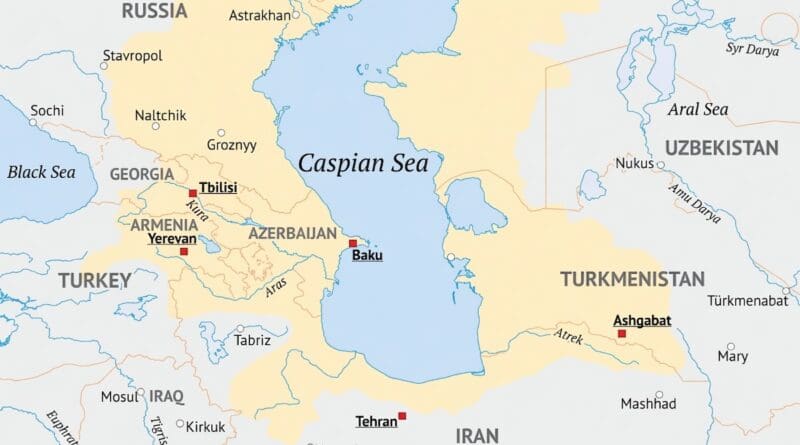
First, Azerbaijan closely reflects Cooper’s concept of niche diplomacy. Rather than seeking influence across all areas of international politics, it has concentrated on several domains where it possesses comparative advantages. Energy diplomacy constitutes the most obvious example. Through the Southern Gas Corridor, Azerbaijan has become an important contributor to European energy diversification, particularly after the Russia-Ukraine war heightened the strategic importance of alternative energy supplies. At the same time, Azerbaijan has transformed its geographical location into another diplomatic niche by becoming one of the principal actors in developing the Middle Corridor connecting Europe with Central Asia and China.
Second, Azerbaijan’s diplomatic behavior closely corresponds with Breuning’s behavioral understanding of middle powers. Rather than defining middle-power status solely through material capabilities, Breuning argues that it should also be understood through patterns of foreign-policy behavior and the roles states seek to perform in international affairs. Beyond diplomatic activism, middle powers frequently act as norm entrepreneurs by promoting new ideas, advancing international principles, and shaping regional or global agendas through persuasion rather than coercion. In this regard, Azerbaijan has increasingly sought not merely to participate in international institutions but to influence their priorities. Its successful chairmanship of the Non-Aligned Movement, active engagement within the Organization of Turkic States, the Organization of Islamic Cooperation, and the Conference on Interaction and Confidence Building Measures in Asia, together with hosting major events such as COP29 and WUF13 demonstrate an effort to promote issues such as energy security, regional connectivity, intercultural dialogue, and South-South cooperation. While the long-term impact of these initiatives remains to be evaluated, they reflect an increasingly proactive foreign policy consistent with Breuning’s understanding of contemporary middle powers as norm entrepreneurs.
Third, Azerbaijan increasingly exhibits the characteristics identified by Carr. It seeks not merely to participate in regional developments but to shape them. Following the restoration of its territorial integrity, Azerbaijan has assumed a leading role in advancing regional connectivity projects, promoting new transportation links and advocating a comprehensive peace agreement in the South Caucasus. Whether every initiative succeeds is ultimately less important than the country’s demonstrated ambition to influence the regional agenda.
Finally, Azerbaijan’s foreign policy reflects many of the stabilizing characteristics highlighted by Cox. While pursuing its national interests, it has consistently emphasized multilateral engagement, diversified partnerships and strategic autonomy. Rather than aligning exclusively with any single geopolitical bloc, Azerbaijan has cultivated productive relations with the United States, the European Union, China, Middle East, Central Asia and numerous countries across the Global South. This balanced approach has enhanced its capacity to function as a bridge between different political and economic regions.
Beyond multilateral engagement, Azerbaijan has increasingly demonstrated another characteristic commonly associated with contemporary middle powers: the ability to facilitate dialogue among actors with competing interests. Rather than acting as a formal mediator, Baku has positioned itself as a trusted platform for diplomatic engagement by providing neutral venues for dialogue on sensitive regional and international issues. Between 2018 and 2020, Azerbaijan hosted several meetings between NATO and Russian military representatives aimed at reducing tensions and maintaining channels of communication. More recently, Baku has facilitated contacts involving representatives of Türkiye and Israel, as well as discussions between Syrian and Israeli officials on military deconfliction mechanisms in Syria. Although such initiatives rarely receive widespread public attention, they illustrate Azerbaijan’s growing capacity to contribute to regional stability through pragmatic diplomacy. This facilitative role further reinforces the behavioral understanding of middle powers as states that exercise influence by promoting dialogue, reducing tensions, and fostering cooperation rather than relying primarily on coercive power.
The Azerbaijani case, therefore, illustrates a broader transformation in international politics. As the concept of middle power has evolved from measuring resources to evaluating behavior, diplomacy and strategic influence, Azerbaijan demonstrates that states capable of strategic specialization, agenda-setting, multilateral engagement and norm entrepreneurship can exercise influence well beyond what their material capabilities alone would suggest. The evolution of middle power theory is therefore not merely an academic debate, but a reflection of the changing nature of power itself.