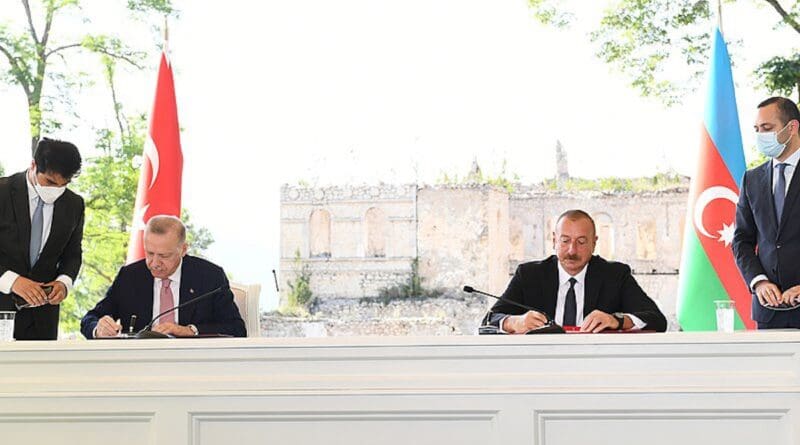
Türkiye and Azerbaijan commemorated the fifth anniversary of the Shusha Declaration on Allied Relations on June 15, 2026. Shortly following the conclusion of the Second Karabakh War, the document was signed in the cultural capital of Azerbaijan, officially elevating bilateral relations from strategic partnership to alliance (President.az, June 15, 2021)
Five years later, the significance of the Declaration extends well beyond bilateral relations. Its broader impact is increasingly visible in the evolution of the Organization of Turkic States and in the growing economic and strategic connectivity of the Turkic world.
Cooperation in energy, transportation, trade, investment, humanitarian affairs, and security and defense was institutionalized by the Shusha Declaration. More importantly, it cultivated the political confidence necessary for Azerbaijan and Türkiye to prioritize long-term regional initiatives. Today, many of these initiatives complement the broader priorities of the OTS and contribute to the organization’s evolving agenda.
At the same time, the development of the OTS is driven by the collective vision and shared commitment of all its members. Kazakhstan, Kyrgyzstan and Uzbekistan have each made indispensable contributions to its institutional and practical advancement, while the observer states have further broadened its geographical scope and diplomatic outreach.
From institutional cooperation to strategic coordination
Azerbaijan and Türkiye played pivotal and complementary roles in the emergence and institutional development of cooperation among the Turkic states. The process began with the first Summit of Turkic-Speaking States in Ankara in 1992 and was institutionalized through the Nakhchivan Agreement, signed by Azerbaijan, Kazakhstan, Kyrgyzstan, and Türkiye in 2009 (OTS). Further milestones followed with Uzbekistan’s accession at the 2019 Baku Summit and the transformation of the Turkic Council into the Organization of Turkic States in Istanbul in 2021, accompanied by the adoption of the Turkic World Vision 2040 (OTS, November 12).
The informal OTS Summit, which took place in Shusha in July 2024, emphasized the importance of climate action, connectivity, and transport (OTS, July 6, 2024). Meanwhile, the Garabagh Declaration furthered cooperation in sustainable development, energy, digitalization, and trade (President.az, July 6, 2024). This practical agenda persisted following Azerbaijan’s assumption of the OTS chairmanship at the Gabala Summit in October 2025 (OTS, October 7, 2025).
Azerbaijan as a bridge between Central Asia and the South Caucasus
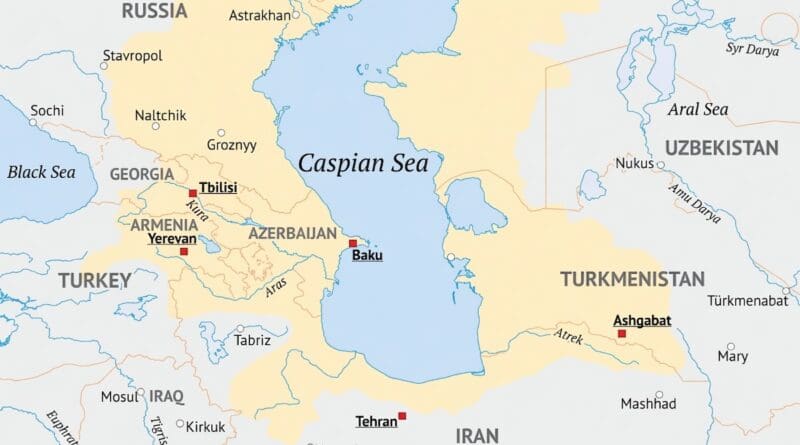
Rather than dividing the two regions, the Caspian Sea increasingly connects Central Asia with Azerbaijan, linking regional cargo and energy flows to Türkiye and European markets.
This increasing convergence was exemplified by Azerbaijan’s admission as a full participant in the Consultative Meetings of the Heads of State of Central Asia in November 2025 (Azertag, November 26, 2025). This admission underscored the increasing recognition of Central Asia and the South Caucasus as integral components of a broader geopolitical and geo-economic space.
Bilateral economic relations further bolster this trend. The sum of Azerbaijan’s investments in OTS member states has surpassed $20 billion (President.az, October 7, 2025). A joint investment company with a total capital of $500 million was established by Azerbaijan and Uzbekistan in 2023 to promote projects in both countries and potentially in third markets (President.az, November 13, 2025). Azerbaijan and Kazakhstan have also established the goal of boosting their bilateral trade turnover to $1 billion (President.az, October 21, 2025).
The $600 million Turkic Investment Fund can make an important contribution to this process by providing loans, guarantees, trade finance, and equity financing (Turkic Investment Fund). By improving project bankability and mobilizing additional public and private capital, the Fund can serve as a catalyst for regional investment and joint business initiatives.
These economic and institutional links are increasingly supported by practical connectivity projects, which give regional cooperation within the OTS a concrete transport, energy and digital dimension.
Connectivity as the backbone of integration
The Middle Corridor links China and Central Asia to Europe and intersects with Azerbaijan, Georgia, and Türkiye.
Freight transported through the seaports of Kazakhstan and Azerbaijan in 2024 amounted to 3.3 million tons, a 20% increase from 2023, as reported by the TITR Association. The number of container trains dispatched from China increased 33-fold, while container traffic increased by 176% to 56,500 TEU (TITR, March 4, 2025). These figures illustrate the Middle Corridor’s rapid expansion and its growing significance in the trade between Asia and Europe.
Major infrastructure projects are strengthening this route. The annual handling capacity of the Baku International Sea Trade Port at Alat is planned to increase from 15 million to 25 million tons (President.az, July 19, 2025). Following modernization completed in 2024, the annual freight capacity of the Baku–Tbilisi–Kars railway increased from 1 million to 5 million tons (ADY). Türkiye is also constructing the 224-kilometer Kars–Iğdır–Aralık–Dilucu railway, which is intended to strengthen links with Nakhchivan and expand the Middle Corridor’s freight capacity (The Republic of Türkiye Directorate of Communications, August 25, 2025).
Physical infrastructure is increasingly supported by digital and regulatory measures within the OTS. The Simplified Customs Corridor Agreement entered into force in November 2024, while the e-Permit system has been launched and steps are being taken to implement e-CMR and e-TIR and integrate national single-window mechanisms (OTS, November 29, 2024, Turkistan Declaration, May 15, 2026). These measures are designed to enhance the efficiency of freight transport, reduce administrative barriers and transit times, and simplify cross-border documentation.
Another pillar of this connectivity is energy cooperation. The TANAP, Baku–Tbilisi–Erzurum, and Baku–Tbilisi–Ceyhan pipelines have long connected Caspian energy resources with Türkiye and Europe. In 2025, the Iğdır–Nakhchivan gas pipeline was inaugurated, which further fortified the energy security of Nakhchivan and its direct connection to Türkiye (President.az, March 5, 2025).
Green energy and digital connectivity are the primary objectives of the subsequent phase. The Central Asia–Azerbaijan Green Energy Corridor is being developed by Azerbaijan, Kazakhstan, and Uzbekistan to facilitate the transmission of renewable electricity across the Caspian and to establish connections with routes to Türkiye and Europe (President.az, November 13, 2024). In parallel, Azerbaijan and Kazakhstan are developing a Trans-Caspian fiber-optic cable between Sumgayit and Aktau, intended to strengthen the digital corridor between Asia and Europe (Digital Silk Way, August 6, 2025).
A driving force for wider Turkic cooperation
By establishing new opportunities in energy, trade, investment, and digital connectivity, the cooperation between Azerbaijan and Türkiye has a broader impact on the Turkic world. The OTS’s forthcoming phase will prioritize the development of more efficient transport procedures, stronger commercial networks, mutual investment, and joint projects, which can translate political solidarity into tangible benefits for businesses and citizens.
The central objective of the Shusha Declaration, which was to institutionalize the Azerbaijan–Türkiye alliance and generate broader regional momentum, has been achieved five years after its signing. Although the OTS’s future will be collectively determined by all of its members, the Azerbaijan–Türkiye partnership will continue to be a significant force that unites the eastern and western regions of the Turkic world and fosters more in-depth economic and strategic collaboration.